Growing up, a ubiquitous response to being asked how you were – regardless of where you were – was to say that you are “just here”. From the perspective of the majority of English speakers on the British Isles, such a response might fairly warrant the question: “where, or what, is here?” Like most mainstreams, the logics of the periphery, its argots and science fictions, are grotesquely opaque until they are desirous and co-optable. Between the marginalia, here is a deliberate illusion that denies the confines of “where” and reimagines our many “theres”. It is as much to do with locating yourself as it is the sites of your communities, values, aspirations, and struggles.
At RESOLVE Collective, our here still speaks to this illusion. From the deindustrialised landscapes of Northern England to the apartheid geographies of illegal Israeli occupation in the West Bank, Palestine, we work in trans-local mutuality with a web of creative practices and organisations who are building community-facing infrastructure in order to subvert, resist, and reimagine a world order that ascribes us to its margins. Though ours is a creative practice that emerged from South London in 2016, it is one that has since put us in constellatory arrangement with sites across the world, learning through our labour and collaboration. These sites – community centre buildings in Liverpool, rhizome routes through the Azorean island of São Miguel, inter-peripheral exchanges between the Parisian suburbs of Montreuil and Corbeil-Essonnes, the Black and Brown Elbinseln of Hamburg, the estuarine cityscapes of Douala – become, momentarily or cyclically, our co-laboratories. Here, learning is a reciprocal act that indebts us to communities and their places.
Of these sites, Sheffield, a city in South Yorkshire with a reputation that precedes it, has held and nurtured our practice in ways that we would have previously deemed unimaginable. We can trace a lineage of experiments in community-facing infrastructure-building through our “sister city”. From a collage of projects and communities, the form of a “residency” holds specific significance for us in Sheffield. It is the site of our first ever residency and introduction into formal cultural institutions. But it is also where we later held our own residency, a peer-to-peer knowledge exchange of Black, POC, and marginalised practitioners from across the UK. It is by participating in, and ourselves holding, residencies in Sheffield, with the networks and groups that have become our working family, that we have sharpened our understanding of what it means to nourish what we call “ecologies of creative practice”: place-based networks of community-focused artists, designers, builders, facilitators, writers, filmmakers, curators, organisers, healers, musicians, and activists, and the organisations, resources, and spaces that make their work possible.
For us, the requisite action for this sharpened understanding is to build collective, community-facing infrastructure that redistributes critical resources – funding, spaces, labour, expertise, time – to those from whom it has been historically ring-fenced from. That infrastructure takes the form of co-operative systems of material reuse and distribution, itinerant pedagogical programmes that celebrate the local knowledge of marginalised young people, alternative financial networks, a proliferation of spaces to gather, learn, and co-conspire with others invested in equitable societal change, and platforms for knowledge exchange that resource community-focused practitioners. This text maps three of our Sheffield projects, illustrating our journey and providing a written scaffold for the nascent infrastructures that are emerging from this work.
The Garage – an introduction into Sheffield’s ecologies of practice
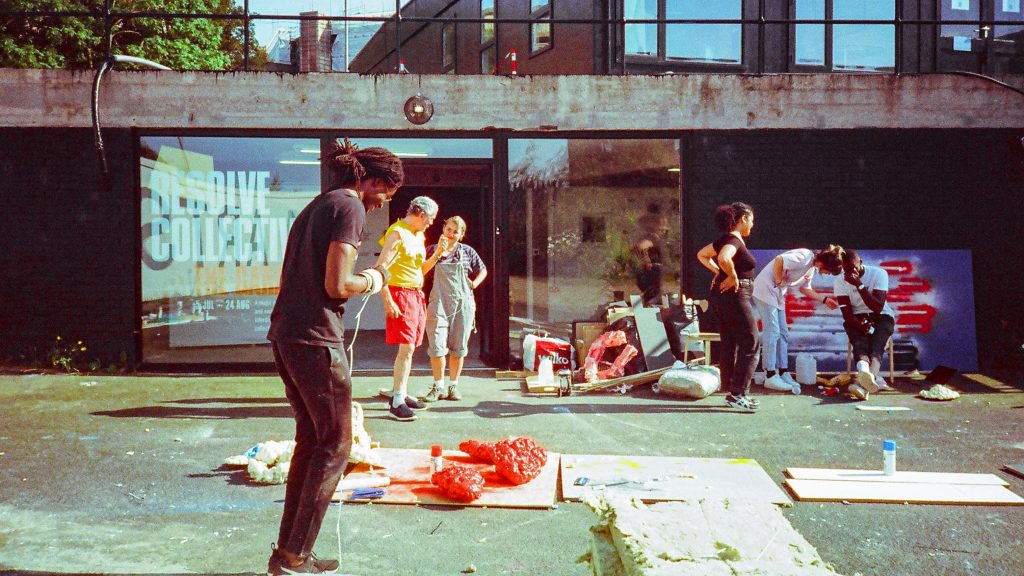
Sheffield was the site of our first ever exhibition and residency, The Garage at S1 Artspace, in the old garages of Park Hill estate – a former icon-turned-scapegoat of post-war social housing, currently undergoing a comparably iconic – and contentious – redevelopment. Here, in 2019, supported by the efforts of dear co-conspirators such as Katie Matthews, Laura Clarke, and Kerry Campbell, we explored local emotional connections to the city through this artist residency, resulting in a public programme and installation that ran throughout the summer months.
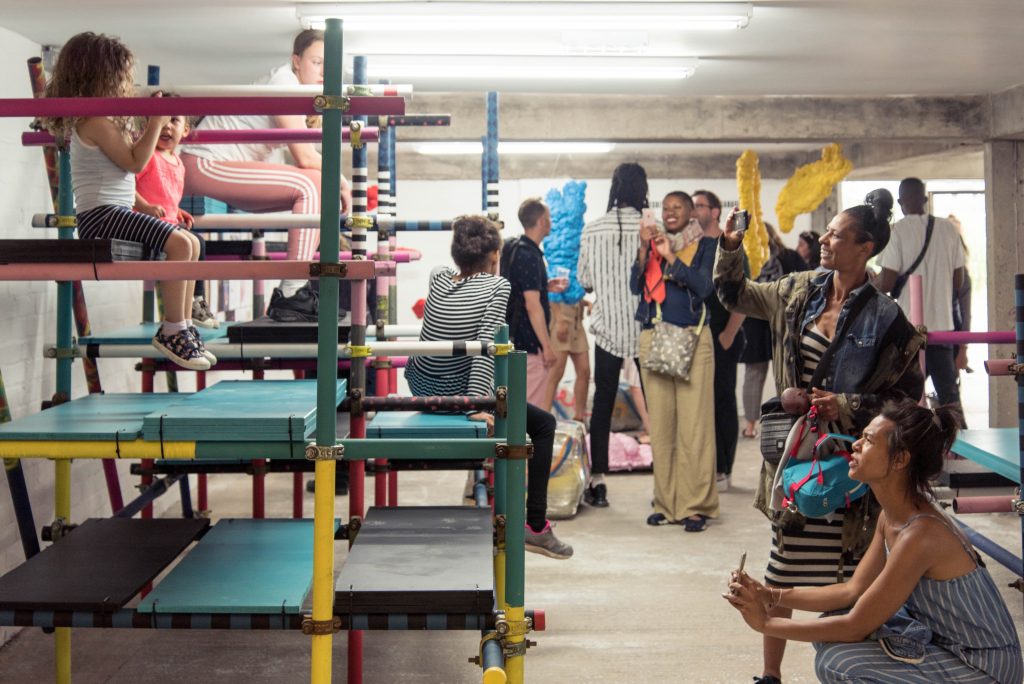
In this installation, created entirely from materials salvaged from an array of galleries and art spaces across Sheffield, including scaffolds from the Park Hill renovation, we interrogated the emotional substrate of our built environments. Reinterpreting the material currency of the city’s network of cultural spaces, we sought to acknowledge the integrity of feelings, intuition, biases, contradiction, dreamscapes, mythologies, hearsay, hidden narratives, and lived experiences in response to the disciplinary question of “city-making”.
Over that summer, we transformed the gallery space into an interactive exhibition that required the clambering, sitting, performing, and resting of our bodies to explore these themes, rather than the passive consumption of information. We worked with an array of local organisations and practitioners, such as the then city poet laureate Otis Mensah, Warda Yassin, UBI Lab Sheffield, Manor & Castle Residence Association, The Sheffield College, and Longley Park Sixth Form, to programme the space responding to themes such as “performing the city” and “mobility justice”. Soon, these connections became our foundations in the city, establishing long-term relationships that we continue to build today.
Nurturing Ecologies – turning our tools inwards
Five years on from The Garage, and our work in Sheffield continued to flourish. We developed a longstanding relationship with civic organisations that we now consider some of our closest allies, such as the Sheffield And District African Caribbean Community Association (SADACCA), Dig Where You Stand, Gut Level, Studio Polpo, White Teeth, Calabash! and Peaks of Colour. We worked alongside cultural organisations and venues across the city, such as Arts Catalyst, Bloc Projects, and Site Gallery, and built meaningful fraternity with practitioners who are now a fundamental part of our own ecology of practice – Grace Lee, Ella Barrett, Jashan Walton, Ashley Holmes, Wemmy Ogunyankin, Amina Haruna (MYNA), Evie Muir, Asma Kabadeh, Kazna Asker, Anisa Nuh-Ali, and many others. As our connection to Sheffield deepened, so did our obligation to think beyond the limits of a project’s scope and toward aiding continual flourishing for the city’s ecologies of practice.
In 2022, during a particularly difficult time for our organisation financially, we facilitated a practice module for master’s students at University College London’s Bartlett Development Planning Unit, titled Sheffield Otherwise, exploring Sheffield’s counter-geographies of race and queer culture, and collaborating with the grassroots organisations in the city who were defining these landscapes.
Though it was a chance to fortify many of our existing relationships, we finished that project with an acute feeling of the power imbalances inherent in serving large institutions in the study of our ecologies of practice. Where, we wondered, is the line drawn between extraction and the short-term financial resourcing of community organisations in these institutional contexts, in the name of work “in the field”? What were the legacies of these closed academic circuits, and who would – and should – be left to uphold them?
Our reflections prompted a phrase we regularly use now: “this work needs labs, not projects”. In order to look beyond ourselves as individual agents of change and toward the networked redistribution of material and financial resources for practitioners and organisations within a wider ecology of local practice, we realised we needed to turn our tools inwards, creating testing grounds for organisational capacity-building from the bottom-down.
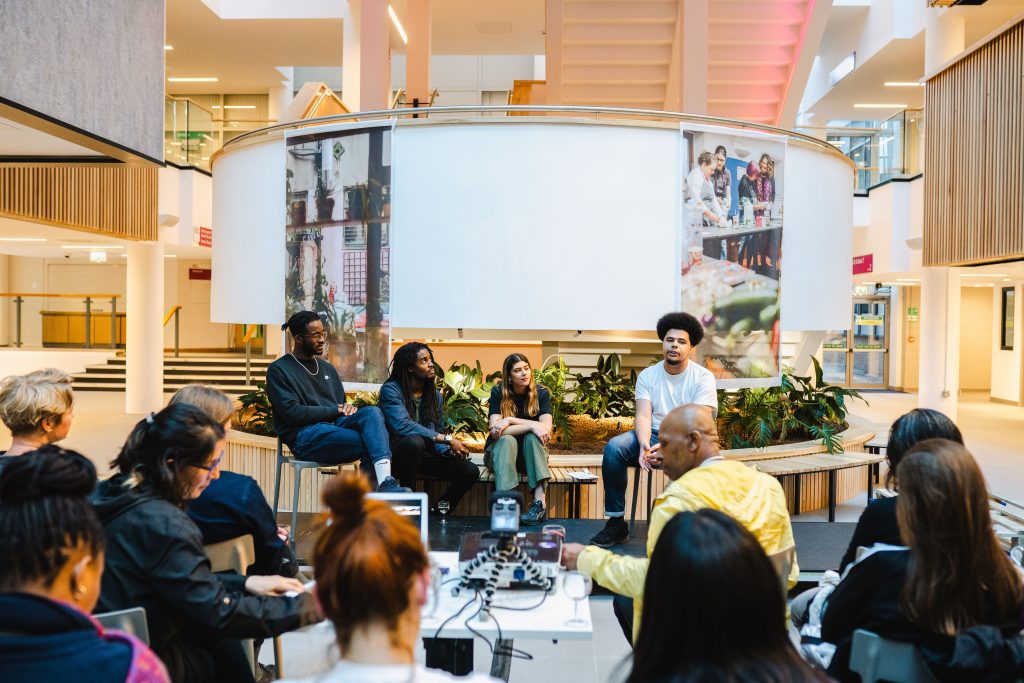
This reflection resulted in Nurturing Ecologies, our residency in Sheffield that brought together Black, POC, and marginalised group-led organisations who champion radical approaches to community world-building through creative practice. By securing funding from the Joseph Rowntree Foundation, the residency programme was able to commission and resource a week of peer-to-peer learning and knowledge exchange, enabling collective development in a series of workshops, events, and activities delivered by its participants.
Themes and topics ranged from inherited remedial knowledge, in a sharing session by curator/producer Shaheen Kasmani and Peaks of Colour founder Evie Muir, to queer Black arts practices in the North of England, in a panel discussion held by curator and gallerist Pacheanne Anderson with Jesualdo A. Lopes of Leeds/Lisbon-based outfit The Blacker The Berry, Sheffield-based visual anthropologist Wemmy Ogunyankin, and Sheffield-based DJ and Calabash! founder, MYNA.
Importantly, by bringing together creative thinkers, practical dreamers, space-makers, and system designers – and situating their practice within the socio-political landscapes of Sheffield – we were able to position a country-wide ecology of practice within local, collective processes of knowledge exchange: learning in equal part from our partners and our site.
PLUS ONE – rehearsals in infrastructure-building for ecologies of practice
In the wake of Nurturing Ecologies, we began conversations with a number of gallery spaces in Sheffield to understand how we could build on the legacy of the residency. During this time, our organisation grew in ways that befittingly entangled us in Sheffield’s cultural skein, with two members of RESOLVE Collective now based in the city and also deeply involved in other Sheffield-based organisations.
It was with this growth – in addition to the support and partnership of not-for-profit artist-led space, Bloc Projects, whose resurgent Arts Council England grant foregrounded our work together – that we were able to continue developing the Nurturing Ecologies framework two years later with a new collaborative project.
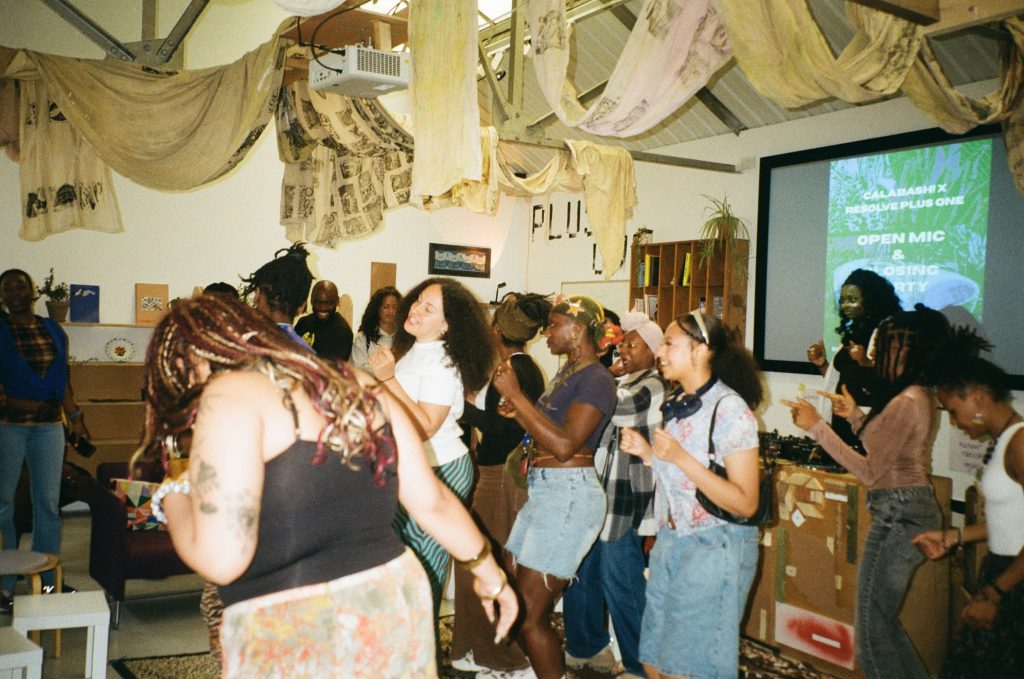
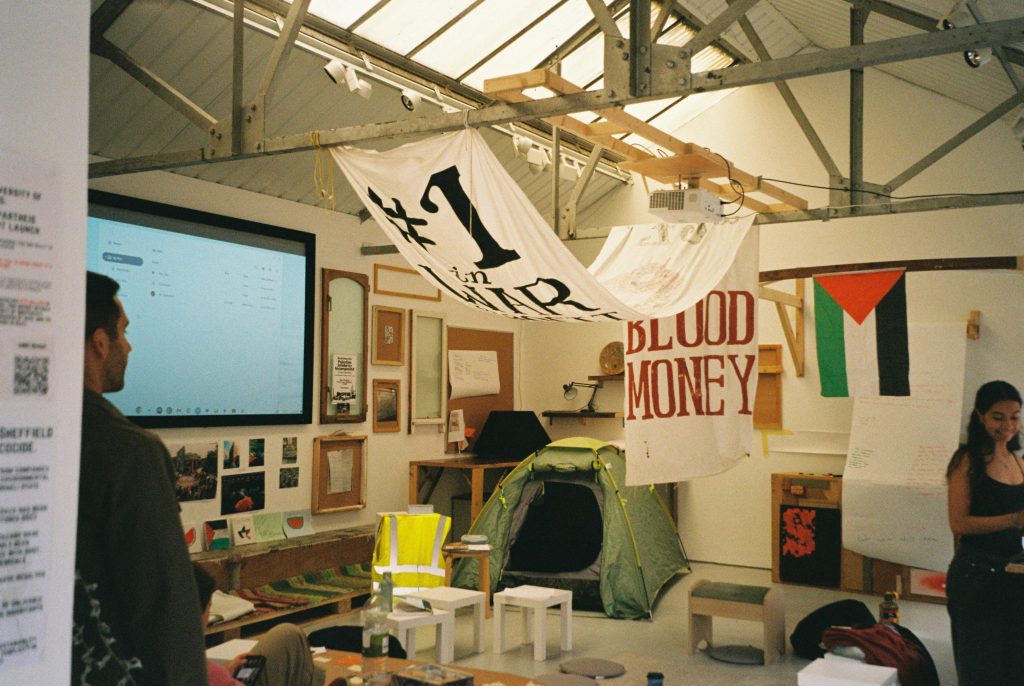
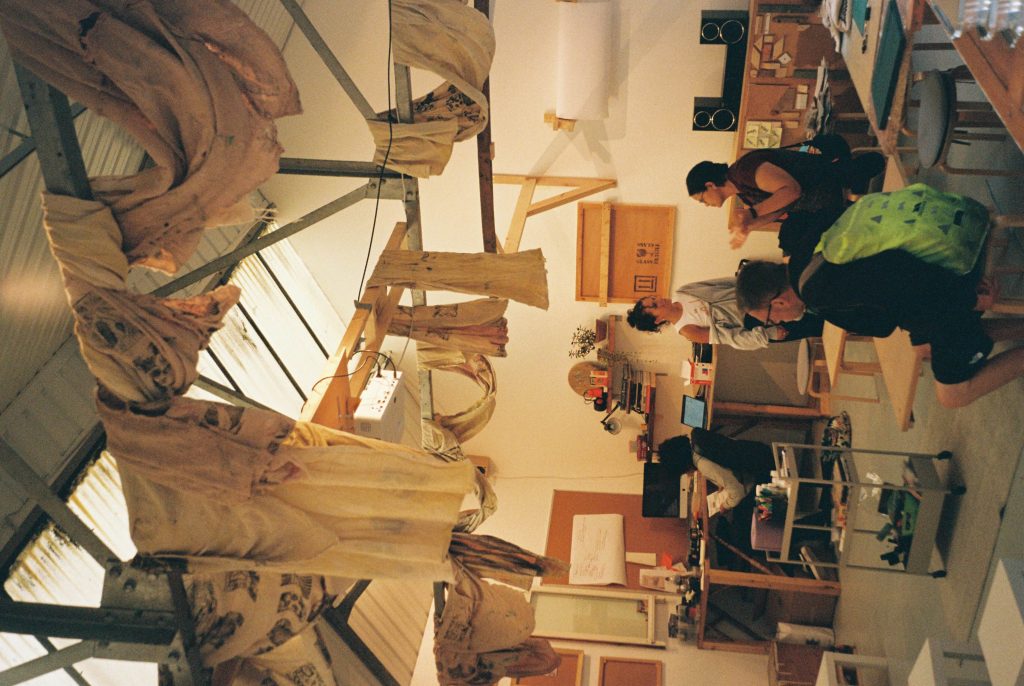
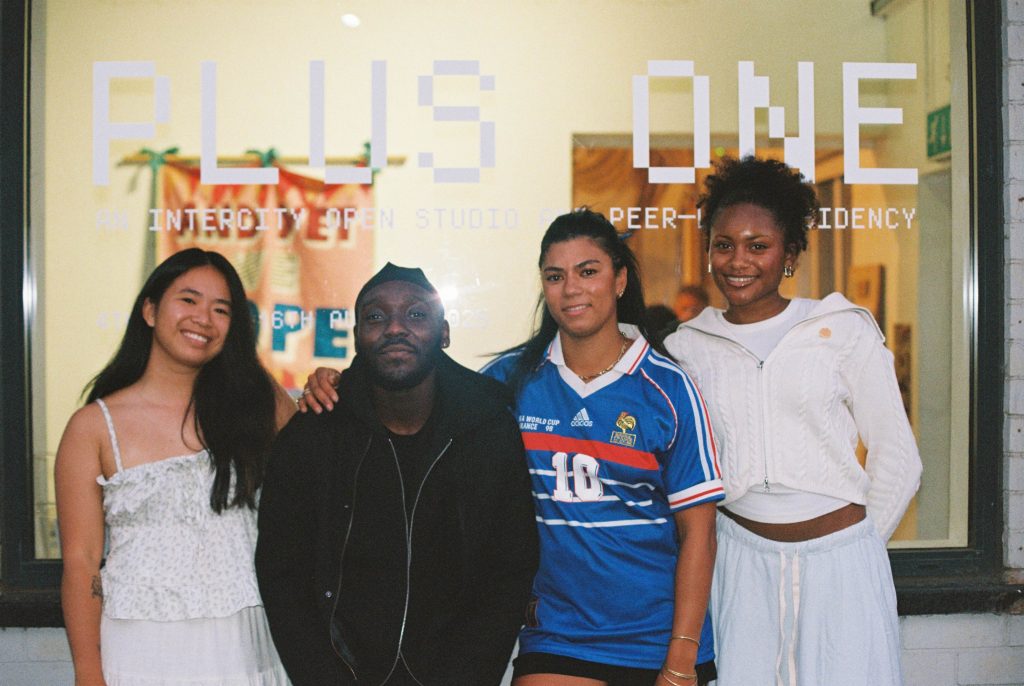
PLUS ONE, with Bloc Projects, is an inter-city “open studio” and six-week residency that we launched in July 2025, inviting three practitioners based in three Northern England cities – Sheffield, Leeds, and Manchester – to use the gallery as a space for lab-style workshop testing, trans-local knowledge exchange, and creative expression that necessitated communal invitation, or what we describe as “bringing your people with you”. We wanted to test what the Nurturing Ecologies framework looked like as a space in Sheffield; to ask, what might the spatial infrastructure to resource community-focused creative practice look and feel like?
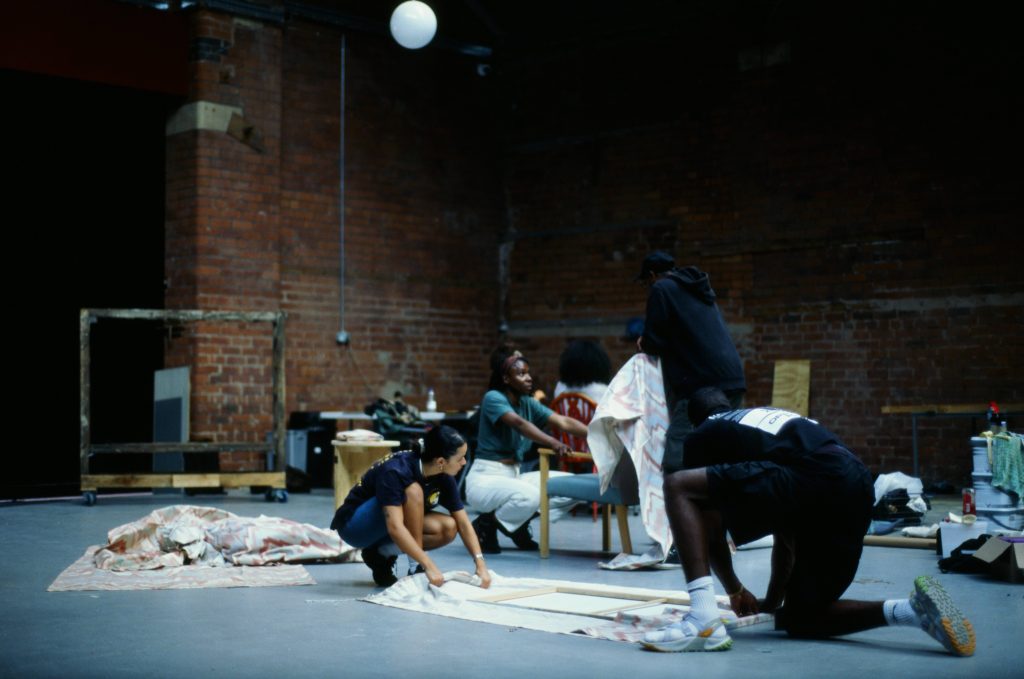
Guided by this question, we built an “open studio” in the gallery space of Bloc Projects, once again using materials we had foraged and salvaged from cultural spaces and organisations across Sheffield. It became a space for assembly but also one to foster connection and facilitate deep collaboration, containing utilities to support various practices (such as a scanner, paints, desks, and office chairs) as well as tools for exhibition and performance.
The project builds interregional connections by facilitating and resourcing not only the work of the PLUS ONE residents – photographer Ai Narapol, musician and sound artist Petrelli Purple, and visual artist Ella Mayamothi – but by using their burgeoning practices to further nurture the creative ecologies of Sheffield and their respective cities.
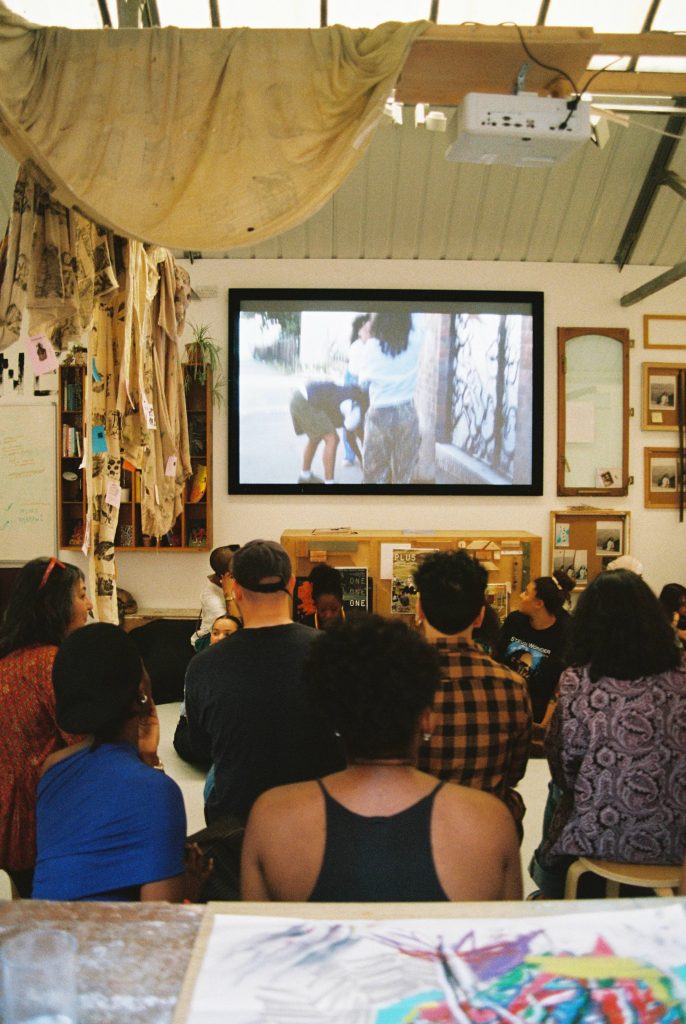
The project had a number of public-facing aspects in addition to the residencies, such as workshops, showcases, and artist presentations. But the paragon of this was the open programming for community organisations across the city, such as Calabash! and the Sheffield Universities Palestine Student Encampments, who were invited to use the space throughout the week. Here, we sought to unravel the idea of the residency as an exclusionary mechanism for individual artistic development and instead play with its porous, communal potential.
At the time of writing this, our colleagues Ella Barrett and Jana Dardouk are redistributing the materials we used to build the installation to groups and individuals across Sheffield. Redistribution is always a difficult part of a project’s end, where previously static building materials confront an animate landscape of niche and common appeal; promises are broken, novel values are realised, and vans become the gold standard in a quiet boom of small reuse economies across the city.
But it does permit an opportunity to confront perhaps unacknowledged relationships to site, or the more covert pluralities of our “here”. On the last day of the redistribution, Ella messaged excitedly in our RESOLVE team whatsapp group to explain the significance of an array of plywood being taken by Jamie Roberts, a DJ and organiser at Groundwork Project, a record label and monthly social in Sheffield. Jamie, she explained, had taken wood from the redistribution of The Garage at S1 Artspace six years ago to make speakers for Groundwork. Now, auspiciously, the speakers needed upgrading and we had more materials to give. It’s an almost unremarkable facet of the work that yet speaks so lucidly to the ways in which this type of infrastructural work leaks out generatively into other projects and practices. To us, it signifies the visible spectrum of these interactions but is indicative of an imperceptible undercurrent. As we continue to build, we insistently imagine our heres in league with and in service to many others. Sheffield as a site, as our residencies, and as, in many ways, our partial residence, exemplifies a visible arrangement of work that resources marginalised ecologies of practice. But it is this city’s more indiscernible resonance – with other locales, practices, and ecologies – that speaks the desirous, illusory qualities of being situated.