PART TWO:
Suddenly, I noticed that I had playfully added a bird and a monkey to the unfinished window
I had painted. To my great surprise, when the window became real, so did the two little animals. I called the monkey Iris and the bird Bamboo. I offered them water for refreshment; they drank thirstily.
– Silvina Ocampo, The Topless Tower
(Translated by James Womack)
We return to the central question to which we are responding here: “What can a design residency do?” Underlying our research and residency programs are designed infrastructures: temporal armatures and spatial architectures for convenings; itineraries for these journeys, even if they are improvised and co-created along the way. A design(ed) residency can create a liminal space, outside of dominant discourses, and well-worn disciplinary routes, and historical institutions, including their buildings. While this does not mean it can elide forms of power and oppression, it can create conditions that are hospitable to what we discussed previously as “complex communication”.
So, returning to the castle, how might one conceive of the defense of such an infrastructure? What castles do we need, and what fortifications? In these times of such incredible global deprivation, social fractures, state violence, and extractivism? And, how can we communicate about our projects in such a way that they are understood and experienced as hospitable, but requiring an intercultural commitment that goes beyond self-interest or existing affiliations?
A hospitable space does not mean one that is free from contradictions, because we all exist within overlapping matrices and hierarchies of oppressions. Yet, just as Paolo Freire discusses “problem-posing education”, it is possible to construct a situation of learning that is cognizant of its contradictions, but also hospitable, in this case, to the awareness of us all as incomplete (Freire, 2000). Toward this, we have witnessed our residencies becoming simply a place of rest; a “temporary autonomous zone” to use Hakim Bey’s term, which we have also refigured in past conversations as a “temporary abundance zone” (Bey, 2003). The question of hospitality has been a theme of the praxical work in our lives; thought and lived alongside other activists, curators, artists, and educators. We think now of our colleague, Okwui Enwezor, who activated, and wrote about, this question. To be hospitable to the un-homed and unhomely (Enwezor, 2006). Creating those spaces, however tenuous or contingent or ephemeral, is very meaningful to us as children of immigrants and displaced people. The power of giving all that you can, whenever you can, spiritually and materially. This also resonates strongly with Gloria Anzaldúa’s sense of the borderlands, and the atravesadas–those who cross borders–recognizing each other (Anzaldúa, 2012).
This returns us to the problem of the term “resident” and its relationship to processes of exclusion. We are living in a period of massive migration, displacement, and expulsions. So “resident” in this sense is also a privileged term of belonging that excludes so many others. And in fact, the term hospitality has become part of the kind of discourse of the day, of a certain sort of policy advocacy for “left” or “progressive” politics. But what is not really discussed is the status of the guest; and the guest is precisely what hospitality is directed towards–ensuring the integrity and safety of one’s guest, and we want to add for emphasis, whether they are invited or not.
There is a very ancient and pervasive idea of the status of the guest. It is important to acknowledge that in our convenings we are all guests, whether we come from near or far; and the relationship to our hosts is reciprocal. We solicit the hospitality of our hosts, who vary vastly from one event to another, to ensure our well-being. We are in transit, but we also have a different status; we are a different kind of traveler, with a different intentionality, and the host understands and supports that. This points to the relationship between host and guest as a deep, ancient form of human, and other-than-human reciprocity. Our residencies have each elicited that, in very different ways.
The status of the guest is something that is well thought across global cultures, in many different forms. Its standard is of reciprocity and social being; not only transactional, but about the interdependence of strangers in a place and those who live in that place. One could also point here to the fact of the ancient conflicts and reconciliations between nomadic and settled peoples. There are many different examples, globally, of hybrid cultures and crossroads, ways of negotiating meeting grounds and border spaces.
This discussion invokes another straightforward question: What is the appropriate behavior of a guest? Of course, the answer is contextual. For example, what is the behavior of a guest who is descended from the very colonial powers that formerly occupied a now post-colonial nation-state in the ongoing process of decolonization. How does one behave if one is in a space in which one is a symbolic embodiment of a long history of oppression? Every site is a conjuncture of complex socio-economic and cultural conditions. Being in a site for the first time, one might now be learning, intimately, about its labor and gender politics, the politics of racialization, and the colonial histories of state control over autonomous and indigenous communities. If one represents an aspect of that long history of colonization that has created the current dynamics of oppression and resistance, what questions are those that one can or should ask? How much listening, observation, and time is required in order to be able to even formulate questions, and to ensure that one is not mistaking oppression for resistance? This returns us to the question of complex communication and deschooling.
Deschooling requires a recognition of the limits of one’s own understanding that has to take the form of humility and not knowing. We have witnessed that, for some, it is very hard to assume humility when traveling in an unfamiliar place. Especially if one is an inhabitant of the “global North”, even as a critically thinking artist, designer, or researcher, one is subject to colonial notions that determine a view of the world as already known. It is a cocooning of experience. At a certain point, one must recognize that entrapment and break out of it. But in doing so, one must remain aware of one’s embodiment of privilege, including skin color, language, idiom, fashion, manners, aesthetic “taste” (Bourdieu, 2010); and not just historical privilege, but contemporary privilege. These forms of power are absolutely present, and can position speakers and their stated experiences as being always correct; and their questions, even if based on erroneous assumptions, as valid. So, “residents” in these positions of contextual privilege might un-ask, rather than ask, questions. They might instead reflect and think: That’s simply not a respectful question; or it’s not a question I can or should ask right now. This is linked to the forms of unknowing that a problem-posing pedagogical stance, and a respect for the right to opacity, we invite. One of our guidelines for our communities’ communication is: “Ask questions. Don’t make assumptions” (the “Meeting Agreement” was developed by CAD+SR with Dr. Lisa Brock, 2018). But this is actually quite tricky; how to ask questions that are not based on erroneous assumptions? This is an excellent research methods question, and quite practical for being a good guest.
A closing question might be: What are the forms of preparation that are appropriate for our trans-local residencies? This very much connects to artist-researcher Leyla Keskin’s online workshop that we held earlier this year, “Understanding Ecological Grief: Emotions and Pathways to Holding Space”. That concept could be extended to decolonizing mourning, which would require understanding our connection to the coloniality of a place and its particular forms and histories of devastation. Leyla’s invitation to us was to articulate our ecological identity by locating ourselves in a particular relational space that we had lost; and then to articulate a goodbye to that set of environmental, geo-political, cultural, or human and other-than-human coordinates. So that we could confront that loss and value that ecological identity in a renewed, and perhaps more committed, way. Perhaps this is also an important exercise regarding how we travel in the world, which is to understand the place that we feel a deep connection to; honor it; and perhaps, mourn it. So that we are not mired in ambiguity regarding how we inhabit other spaces. Because we have to be able to reconcile ourselves to our own mourning and loss, in order to be able to honor other spaces, and to open ourselves to the fact that we may be interconnected in our mourning and our dislocation. This is a recurring phenomenon in our work; the unwillingness, misrecognition, or displacement, of profound affective connections to place, especially when it requires the acknowledgement of multiple displacements, forced migrations, and expulsions. This is a form of othering that distances one’s own embodiment in that place, and all places, because that reckoning has not occurred. This discussion, by the way, is also on a continuum with Paul Gilroy’s insistence on coming to terms with colonial history (Gilroy, 2005).
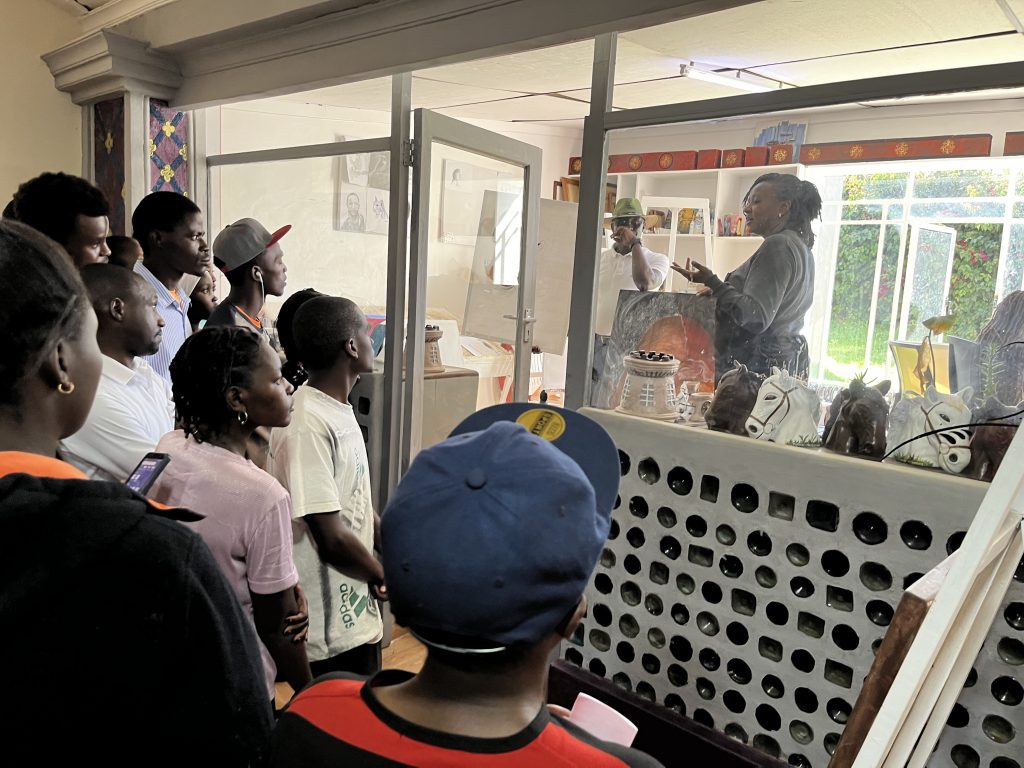
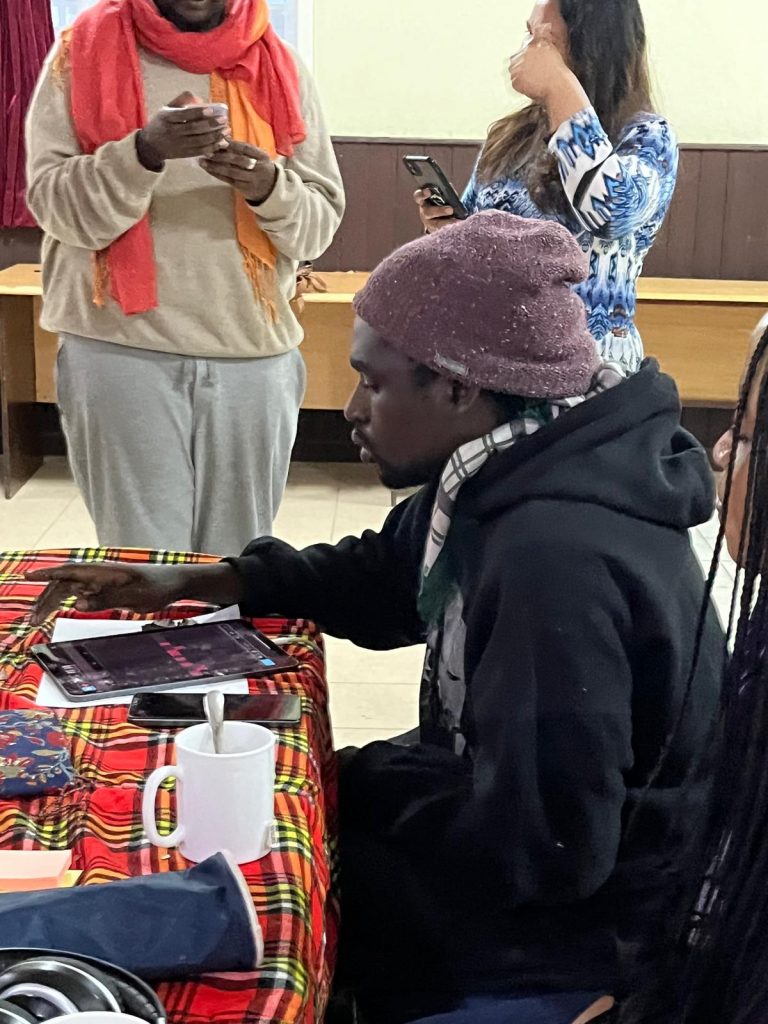
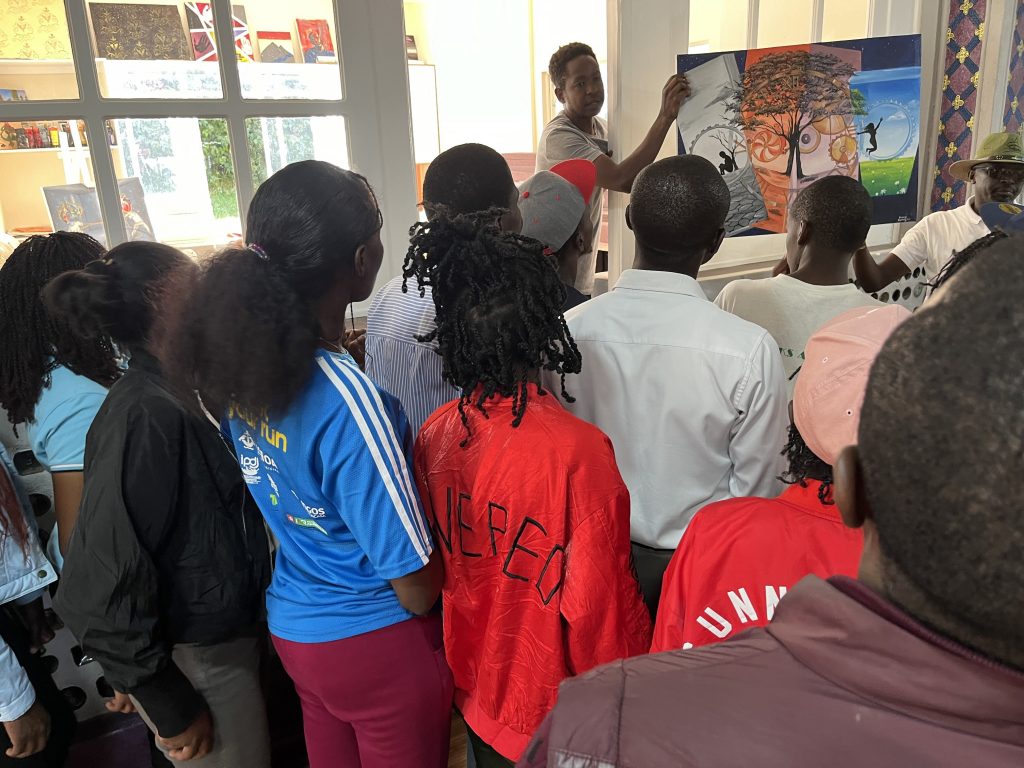
On the other hand, the opposite phenomenon has also occurred in our residencies: the profound recognition of one’s experience in a place becoming intertwined to other experiences in other spaces, including those that one holds close. The line between the self-other, one’s own place-the other’s place, becomes blurry. The sense that one has of what is to be designed, and with whom, becomes totally transformed in this new scenario. Both of our residencies at the Tafaria Castle and Center for the Arts culminated with acts of hospitality and generosity, through which guests became hosts, and hosts willingly accepted the invitation to be guests and inhabit their familiar spaces differently. These took shape in two different forms: First, a day of visual arts, digital media, and music workshops, followed by the collaborative cooking of foods from different culinary traditions by the CAD+SR research community for the academic staff and students of a local vocational college, Laikipia East, along with the staff of Tafaria. During the second residency, another series of workshops were carried out, including community building led by Research Fellow Sun Chang, zine-making led by Ras Mengesha, sound sampling led by Kamwangi Njue, and poetry, led by K’eguro Macharia, that included the international researchers in the residency and members of the artists community already present at Tafaria, Wanjiku Nderitu and Maria Gikuru. In the latter workshop, we collectively wrote a poem based on Tim Blunk’s “for comrades who ask, “what is to be done?” during this particular historical conjuncture, a (partial) list of practical things to do.” One of our lines was: “build a castle”.
- A fugue and a poem
Once upon a time there was a castle. It was built on lands that had been taken away from, then reclaimed by, its builder. Its architecture echoed ancient memories from many different places, including the forms of past ancestral inhabitants and of the former occupiers of the land, some still nearby. It also echoed forms that were stolen from other territories occupied by the same settler-colonialists. This castle is a re-emplacement, a fairy tale architecture invoking both a local history of anti-colonial resistance and a globalized, “Medieval Castle” vernacular. It is a difficult, thick space that defies reductive analyses.
Syncretism is not only an aesthetic; it’s a political and ethical disposition against purity. The flattening of human potentialities and realities by forms of domination is enacted by an insistence on purity. If a subject enacts a design maneuver outside their presumed arena of cultural competence, they are at risk of being deemed to be fakes, strivers, or traitors. The syncretic; the hybrid; the translocal aesthetic; the expansive, interconnected imaginary that exists in all localities is a threat to colonial thinking and its puritanisms. In response to the oppressive tendency to reduce complexity, Trinh T. Minh-ha invites us to “speak nearby”, allowing for the apprehension of “radical ‘impurity”…”(Trinh, 1991).
Architect Giacoma Di Vieste, After School Research Fellow 2024-25, alongside the residency at Tafaria, writes: “Also interesting is the coexistence within the space of memorial spaces and possible spaces, spaces open to the possibility of something happening that is not prescribed. Necessary new gestures, becoming new rituals, but what role does memory play?…Again and forever, architecture accompanies the gesture and is generated by it” (G. Di Vieste, November 13, 2024, personal communication).
Further questions we might ask, nearby: What constitutes architectural restitution, in Kenya and elsewhere? What might a restorative design justice practice undertake? What is to be restored? Where does the design process begin and end? What is the ethical, political, relational, and aesthetic disposition required by “impurity”, and how does this change our sense of “justice”? How does one, as a guest, calibrate one’s own responses to a castle of such complexity, a gesture that has generated an architecture? And:
Who can build a castle and why would one want to?
I fill the mold with sand
child’s hands help me
And together, we flip over the
Mold.
There it is, a perfect
Little
Sand
Castle.
I also remember
with my brother,
Building castles in the sand
we are on one of the coasts of the “americas”
We build castles by gathering wet sand
in our hands
allowing it to drip
Between our fingers
To form drops of matter
Together creating
spheres and other volumes.
2. What is to be done, and dysphoria
Is everybody now basically subject to a form of spatial dysphoria? Yes, and let’s remember the work of our colleague Jodi Rave Spotted-Bear, who writes about the dysphoria of fracking on the Indigenous homelands of the Mandan, Hidatsa, and Arikara Nation (Spotted-Bear, 2019). It seems that the modern/colonialist capitalist world-system has created this pervasive condition. And as artists, designers, and researchers we have to contend with that difficulty or, in a sense, malady. Many of us carry within us a “where” that is distinct from where we actually are. To understand where we might be or where, in fact, we might go, is essential to any kind of deep, transformative encounter because otherwise, it just becomes a game of mirrors. A misrepresentation, a kind of fanciful misrepresentation, of where one is, who one is, or where one locates oneself; and then, worse, where one finds oneself related to different spaces, places, and people. And so, somehow, we have to reckon with that dysphoria, embracing its impurities and hybridities; finding new ways of being in proximity, creating forms of collectivity and coalition resulting from the reconciliation of the opacity of our differences.