“Sympoeisis is a simple word; it means ‘’making with’’. Nothing makes itself; nothing is really autopoetic or self-organising […] Sympoeisis is a word proper to complex, dynamic, responsive, situated, historical systems.” [1]
Theatrum Mundi is a centre for research and experimental learning that seeks to reimagine our cities and who has agency in making them. We do this by facilitating inter-disciplinary and inter-generational conversations that bring diverse practitioners together. Through co-creation and knowledge sharing, we develop methods for world-building and storytelling to imagine alternative narratives for our cities.
In 2022 we initiated the educational programme PolyVocalCity with the will to generate knowledge through making and hence generating new strands of research informed by lived experiences. After its first edition, we felt the need to anchor the programme in a specific place, and since 2023, we have been running PolyVocalCity from Croydon Town, part of the London Borough of Croydon, a local government district of Greater London. Croydon has gone through several developments and redevelopments throughout its history. In the 1960s, Croydon became a major commercial district housing some of the biggest brands such as the Nestlé building and the Whitgift Centre, which was for a while the biggest in-town shopping centre in Europe. But Croydon is also associated with law enforcement, housing Lunar House, an immigration reporting centre. For some people, it’s a place they have to go through to regularise their status, for others it’s simply a shopping destination. But for some, it’s a home, a place that houses communities and their history. Croydon was a key place in the birth of dubstep, its art school (now part of Croydon College) was attended (briefly) by David Bowie, and art organisations such as Turf Projects and Stanley Arts contribute to its diversity, its dynamism and making it a place worth visiting and living in.
In the last few years, the area has suffered economic decline and the level of poverty is high in a borough which declared bankruptcy three times between 2020 and 2022. Croydon is currently living through a new phase of redevelopments, and its communities are facing new challenges as a result of aggressive strategies by private developers and public bodies’ political and economical strategic failures.
The first thing that popped into my head for this introduction is a song by Robert Wyatt called Shipbuilding. I’m not sure why, it just came instinctively. After looking up the song, I learned that the version sung by Wyatt was written by Elvis Costello and the music was by Clive Langer. The song talks about how a town comes to prosperity building new ships for the war (The Falklands War of 1982) while its young people are sent to their death fighting the very same war. The song was made to commemorate people who lost their lives fighting a war that did not concern them and their collective pain. The song evokes the duality and complexity of how the regeneration of a place can both bring wealth and destruction for its communities.
And then we have this word, Shipbuilding. What an evocative word if we understand it as a building afloat, a moveable home, a Noah’s ark or perhaps a tool for destruction?
As Wyatt sings, “Is it worth it?”
Or, is this the end of a community, the displacement of people and the erasure of their memory?
What makes a place, a place?
When conceiving the PolyVocalCity: Re-Staging Croydon edition, we wanted to invite practitioners to propose new narratives for social and environmental justice in Croydon. It was clear from the start that this could only happen by engaging with the people who make that place. We could not have engaged with Croydon without the invitation of our peer organisations Turf Projects and The Croydon Placemaking team, who were able to introduce us to its communities and the richness and complexity of its history and its current transformation. We could not have engaged with it without creatives who live and work in Croydon and could guide us through its subtleties, hidden gems and its stories. Only through the people and their life can you really engage with what a place is.
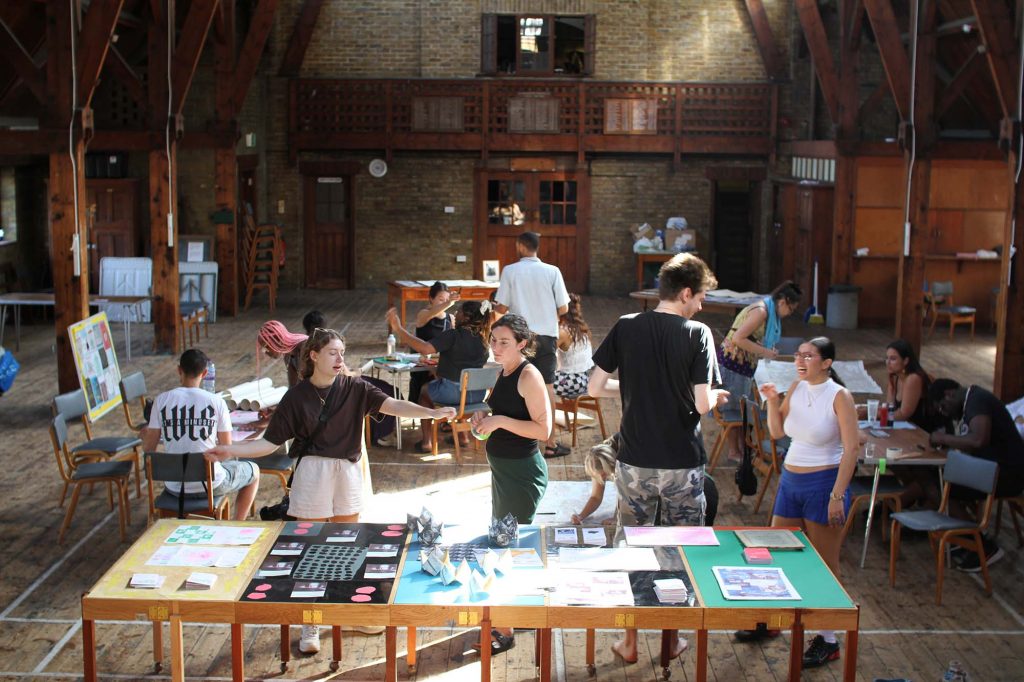
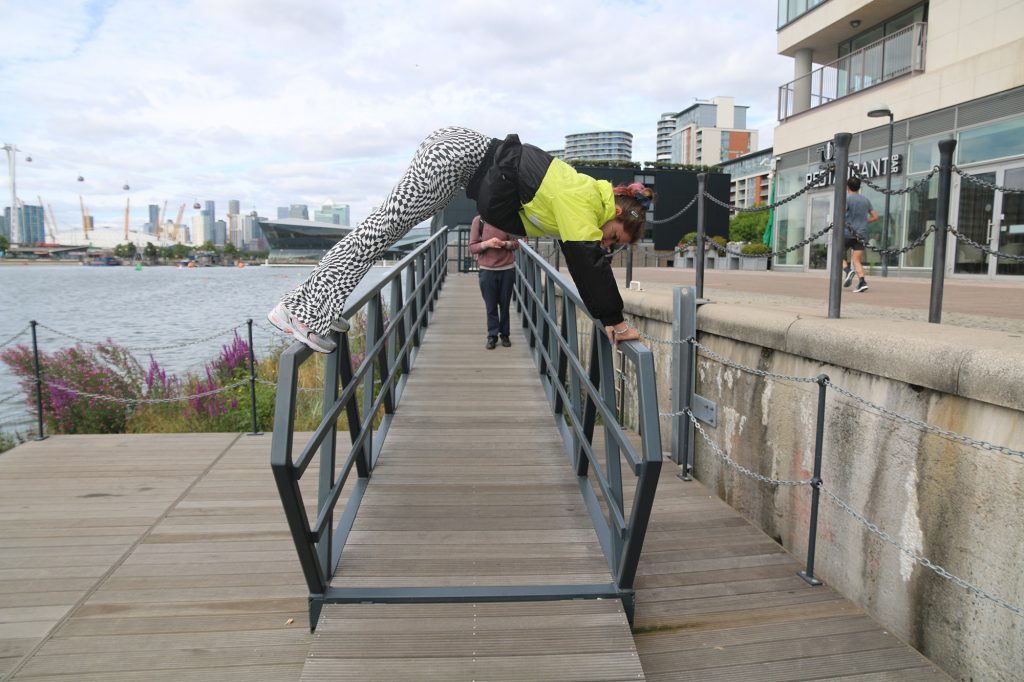
The programme adopts a non-hierarchical model for knowledge exchange, bringing together academic and lived experience. Participants learn from one another, alternatively becoming teachers and students. Through that process, a new kind of relationship emerges, one that is based on making with and a mutual respect gained by exposing each other’s strength and vulnerabilities. Beyond working together, relationships are formed by hanging out, eating together, going for a walk, being blindfolded and guided. A process of trust is established and from those experiences, participants are able to make kin with each other and the place they share.
As Donna Harraway describes it in her book Making Kin Not Population:
“We use the term “making kin” in two ways here – both processual. One is “making for the first time” as in reproduction or creating a new relationship. But “making” also refers to the daily actions that transform partial relations into deeper ones, kinship crafted through the exchange of things, sharing activities, and other practices. This second sense of “making” is how kinship is sustained over time. Thinking about making kin the second way, we grasp that kinship can be blocked, broken, repaired – indeed the very ability to make, have and maintain kin can be stratified.” [2]
The programme’s success lies in these processes of making with, making for each other, crafting “nameless relations” [3] through intimacy, one that can only be acquired through time. We were concerned that the programme could only superficially engage with Croydon, but through these experimental processes and a will to not come to any definite conclusions, participants were able to make kin with the place and form individual and collective relationship with its communities.
The different contributions by Markas Fortunatas Klisius, Rebecca Sainsot-Reynolds, Robin Finch Pickering and Betty Owoo, are propositions to engage with Croydon using storytelling as an access point, an entry into a place that we might or might not belong to but can all share a sense of commonality with. Through a journey of rituals, routines and improvisations, Markas and Rebecca invite us to dive into Croydon’s histories of care, solidarity and resistance, while Robin takes us on a walk through “Croyden”, inviting us, using a series of prompts, to notice the invisible, the disregarded and go off track to commune with the place in new ways. Betty embarks on a self-reflecting journey in Croydon with a series of field notes that explore how “sensory experiences can offer a new reading of Croydon and grow into strategies to retain the multifaceted identity of a place.” [4] In her conversation with B. Atherton, director of the artist and community-run space Turf Projects, they discuss artistic processes to conceive alternative futures.
Making kin is a process requiring an openness to vulnerability and slow encounters. It’s an invitation to make relations and to belong to worlds we imagine together. Making kin becomes the learning methodology that enables us to connect to a place, its human and more-than-human.
What if one imagines PolyVocalCity as something more like a residency, how would it differ from today, being an educational platform, and what would it take in terms of organisation, space, temporalities, responsibilities? What would it possibly add to the educational space?
The model for PolyVocalCity is based on another project called School of Ronces, that I set up in 2018 with a designer friend, Paquita Milville, who runs a residency/maker space called SEMIS in Picardie in the north of France. School of Ronces was initiated to fulfil our desire to carve time for ourselves and create space for others to spend time, work, play, converse in a non-pressured and non-transactional environment. We wanted to work collaboratively, first together but also inviting others to join us. We wanted to establish a space for learning, in a non-hierarchical set-up, where experiences, whether academic, skilled, or life-based, are valued in the same manner. From discussing theoretical concepts to working with clay and pickling beetroots, every knowledge was welcomed and sought after.
The residency format allowed us to welcome people in a domestic environment and create familiarities. It allowed us to spend a concentrated amount of time together and form friendships away from everyday life constraints. It allowed us to go beyond work and learn about each other past the surface. It’s a joyful yet intense process. In this format, learning was at the centre of everything—learning about each other, learning from our experiences, learning to work and live together, and learning to make with one another.
PolyVocalCity was shaped from this experience. The programme places itself as a hybrid between a residency and a knowledge exchange platform. However, it had to adapt to the specificity of its context, both in terms of its spatiality, temporality, and funding structure.
As an educational programme, its ambition is to bring together a range of people who are at different stages of life, have different yet converging interests, and can share their differences. Beyond the learning aspect, what it tries to emphasise and support is the intergenerationality of sharing knowledge, something that I feel is disappearing with over-availability of information online. PolyVocalCity aims to create a meeting point for participants to weave a support structure at a time of transition in their practice and life. What it allows is for participants to become aware and acquainted with the culture(s) of the city they share. This can result in intense and difficult relationships, hard but fruitful conversations, but also generate greater respect, strong friendships, and unique collaborations for participants. A lot of participants expressed this intensity in their feedback and how the programme has been simultaneously difficult, wonderful, and unique for them.
In the first year of the programme, beyond the pedagogic format developed in School of Ronces, I tried to carry out what I found to be the most important aspect of a residency and what cements a group together: cooking and eating together. I made it a rule for the group to share meals and provided food for every session. During this first year, we had an incredible group cohesion, and I think that was down to the time we spent together at mealtimes, when everyone was relaxing into sharing deeply personal stories and leaving their institutional self at rest. This was lost a little in the consecutive years as we focused more resources towards producing the public outcome. I think it was an oversight on our part, and it’s something I will aim to bring back to the next cohort, as it became apparent to me that it might just be the most important aspect of a learning programme: to break bread together.
Using the other text as a foundation, it would be worth describing a little more how participants find their way to the programme, the relation with the local context, organisations, and people. I’m also curious about the cross disciplinary aspects of the programme and what this means when it comes to exchange and production of knowledge?
The programme is advertised through an open call, which is distributed across our various platforms as well as shared by our partners and broader network. This allows us to reach out to new audiences from a hyper-local to a national context. The programme is aimed at creatives who are from underrepresented backgrounds and have a connection to Croydon or London. The programme is interested in looking at the local as outlined by Jeanne van Heeswijk “a condition that embodies global conflicts site-specifically.”[6]
So in that sense, while it’s important to be embedded in a locality to engage directly with a place, the questions raised throughout the programme can be relevant and reflect a shared experience. On average, 50% of participants have a direct connection with Croydon, either because they are from, living, or working in the borough, while the other 50% are from across London. Our hosting partners have been embedded in Croydon for years and know its cultural landscape very well. Both Turf and The Urban Room work with artists and other creatives in Croydon and facilitate public engagement with the local community.
While PolyVocalCity is not directly aimed at working with the broader local community, the programme is interested in facilitating engagement through its final outcome which has taken the form of exhibitions, public events, and podcasts, amongst other things. Building up relationships with local groups takes time and resources that we can’t yet afford, and skills we are slowly developing. To avoid tokenistic gestures, we made a conscious choice to focus on the community we know and have been working with for years: creatives. We believe that by supporting creatives that are connected to a place and are embedded in their own communities, we’re not only supporting the individual but can potentially support an entire community in the long term. Participants taking part are given the opportunity to take risks and challenge their practice. After the programme, some participants have developed and collaborated on community projects, others have secured Phds based on ideas they developed during the programme.
Most participants are interested in taking part because of the multidisciplinary and multigenerational dimension of the programme. In practice, this means having, for instance, young graduates from architecture who are not interested in building buildings but in exploring what a built environment might look like if imagined from a sonic or movement perspective. The weaving of skills and interests means that disciplines are exploded to create new thinking, leaving conventions aside and challenging the status quo. The speculative conditions in which they collaborate enable them to push their own boundaries and come out of their comfort zone.
We split participants in groups, taking into account their interests, skills, and what discipline they wish to explore during the programme. Groups are divided between our four core themes of storytelling, sound, choreography, and infrastructure. We try to create balanced working groups with people who have very different types of experiences and skills and are at different stages of their life and career—but group dynamics can vary greatly. While we are giving them a framework to work with and support through mentorship, we expect them to peer-lead their work and give them the freedom to explore the ideas that feel the most relevant to them within the problematic we have chosen.
Some will adopt a very democratic working system, some will prefer to have a lead, and some work in discord! But because of the multidisciplinary/intergenerational nature of the programme, everyone respects others’ expertises in terms of skills and knowledge. Which means that quite naturally, people will lean onto each other to lead on different parts of productions.
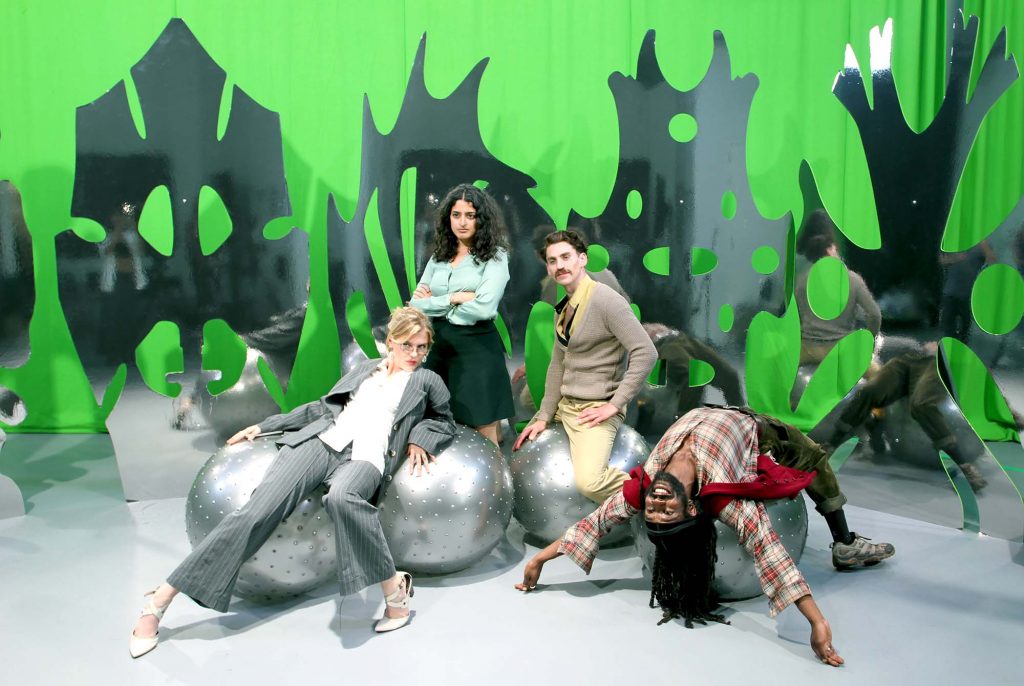
For instance, for Parasite TV, one participant composed the soundtrack for other groups. Another initiated the design of a collective zine. It was a prerogative of the programme that all participants work together on the production of the TV shows—filming, recording sounds, building the set, and acting for each other.
What you started to see happening was a system of care amongst the groups taking place between participants. Some with more experiences organising projects helping less confident participants to explore new grounds and voice their ideas. Sometimes, group dynamics could go off completely and need to be mediated by mentors and the production team. Not everything went smoothly; a lot of intense episodes happened amongst the group, including with organisers. I think it’s important to acknowledge this as part of the learning process. These kinds of projects are intense, they demand a lot of participants and the support team. Especially when time and resources are restricted and ambitions are big! It doesn’t mean the care is overlooked, on the contrary, it shows people’s desire to produce something meaningful for themselves, their peers, and the audience they are presenting their work to. I think that is the most important thing people take away from the programme and the learning experience: it’s not about the outcome but about the process. And the process is full of flaws, is multiple, and is never final.