Mary Jane Edwards
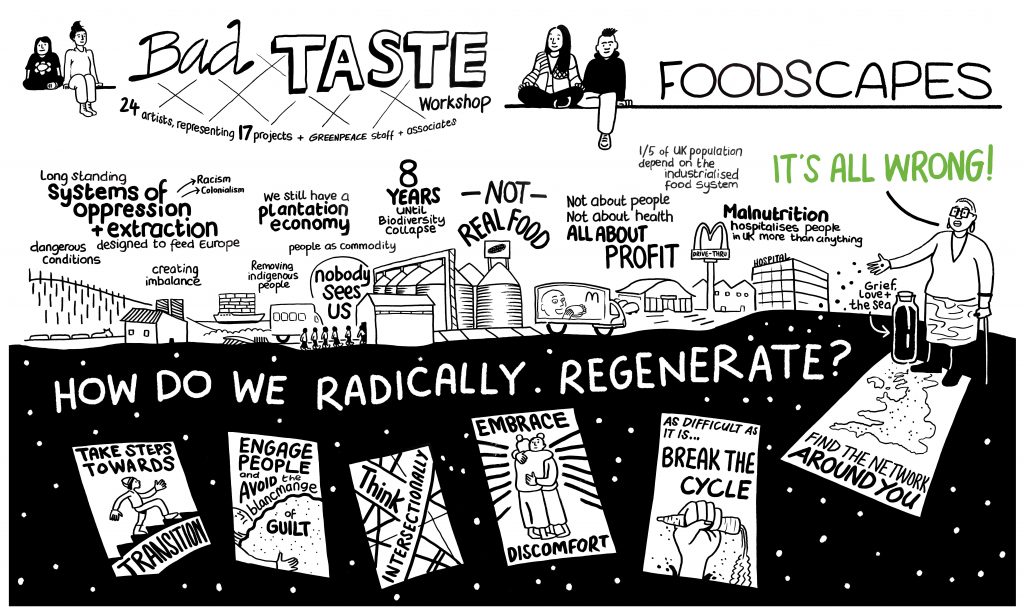
When we conceived Bad Taste, our intention was to find new ways to illuminate the networks of destruction and consumption that link the industrial food system and meat production to deforestation. We wanted to shift the focus away from individual consumer choices and instead highlight systemic responsibility—how corporations like Tesco sustain an extractive system that thrives on Amazonian deforestation and soy production. The industrial food system is such a complex construct of power, profit, and ecological violence that we felt that new approaches and imaginative strategies are required to unpack the issue.
From the outset, while the projects were intended to physically take place at sites of political and corporate structural power, the work required a different approach since it wasn’t a traditional campaign. It was a hybrid of activism and artistic and creative intervention. Inviting an artist at the conceptual stage, not only during production and delivery, was critical to ensure that another perspective was embedded in the development process, challenging and reshaping the work as it evolved.
Following the tradition of the Artist Placement Group, the project required a perspective that could hold complexity and navigate abstraction. In this case, the artist could seed new methodologies into a space that, while deeply experienced in direct action and campaign work, was not necessarily structured around artistic research and less outcomes focused creative exploration. I have always advocated for relational rather than fixed structures for roles such as this, be it as an ‘associate’ or ‘in residence.’ The loose associate model also offered a fluidity and more peripatetic mode of operating that allowed for mutual influence and became an integral part of the project’s unfolding logic.
Alongside Hannah Davey, my role as co-convenor was to help create the space and the conditions for these interconnections and a shared language between internal and external teams. At times, this was challenging due to the pace of Greenpeace’s day-to-day operations and structured ways of working. We also tried to ensure that the artist’s presence was generative rather than superficial and that, ideally, the engagement had an impact beyond the duration of the residency and project itself.
The informal acts of hosting—introductions, shared meals, and casual conversations—were just as essential as the formal structures of collaboration. They created the conditions for working at the speed of trust, which in turn enabled deeper engagement with the project’s more political and strategic aims and interfacing with wider teams within Greenpeace. This reciprocity was key since, in some way, the boundaries of the institution’s approach to campaign design were being stretched, just as the role of the commissioned artists was expanded to include direct action and, to some degree, campaign communications.
Looking back, I see Bad Taste as an experiment in co-inhabiting a process and exploration in convergence. What does it mean to embed artistic thinking within a nonviolent direct action campaign from the start? How does activism shift when it allows for different kinds of time, attention, and speculation?
Time has passed since the last public intervention and conclusion of the project, but between the core team and many of the artists involved, we continue to explore these questions. Not just in retrospective reflection but in the ongoing work that has emerged—collaborations that have extended beyond the initial association, evolving into new artistic inquiries imagining new possibilities for art-led action.
Harun Morrison
Across 2023 I worked as an associate artist on a campaign called Bad Taste at Greenpeace UK, exploring the relationship between deforestation and industrial meat production. The focus of the campaign was not on the individual consumer but illuminating the production chain and environmental networks. i.e. that deforestation of the amazon was taking place in part to clear land for soya plantations, the soya in turn used as a fattener for cow, sheep, pigs and so on, their meat is then processed and purchased by large supermarket chains such as Tescos. The placement was physically situated, the Greenpeace UK offices in North London, meetings were also online. I was primarily hosted by Hannah Davey and Sandra Ata in the Actions Team.
I had spent short amounts of time in the building on previous occasions, primarily doing Nonviolent Direct Action Training and knew some members of the team from previous work.
Their offices are in North London. Thinking in terms of residency and hosting – there was an openness to the situation as we were simultaneously working toward an outline that had been developed with some aspects more defined than others.
My time at Greenpeace was mediated by a pre-existing friendship with Hannah and project convenor Mary Jane Edwards. What this meant in practice was that there was never an explicit articulation on what it meant to be host or guest, but a series of acts and gestures put this dynamic into action. Parallel and interwoven with legible acts of hosting were the unarticulated micro-gestures that signaled warmth and acceptance. The former included:
-Being introduced to other members of the action team
-Enthusiastic tours of the facilities
-Offered tea or coffee, or fruit.
-Invited to sit in on other meetings.
-Invited to join staff at their dinner for lunch in the Greenpeace canteen
The softer gestures included:
-Invited to after work drinks
-Informal coffees at lunch
-Seeing exhibitions together that are not part of our formal research trips
-Exchange of books, memes and other links on social media.
From early in our discussions the Artist Placement Group conceived by John Latham and Barbara Steveni was a key reference point. Especially because I was an artist in a non-art / design organization. This meant that while design and working with artists has been integral to Greenpeace’s work since its initiation, my placement was a departure from how Greenpeace typically worked. In that a) artists and designers would typically be brought in at the realization stage of an intervention or action b) whereas during the Bad Taste placement I was assisting with the conceptualization and shaping of the project itself. In practice this meant more behind-the-scenes discussion with the hosts, and I myself helped host or introduce other artists into the project. So I wasn’t a resident in the sense of being a singular focus of the organization, but closer to being temporarily part of a department, specifically a campaign within the organization.
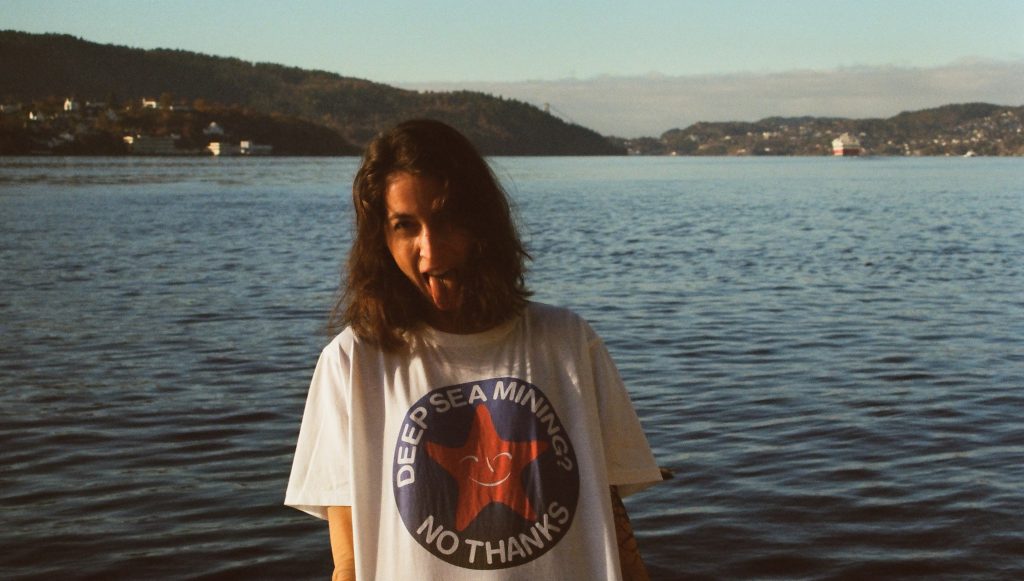
While my focus was on Bad Taste there were also opportunities to sit in on other campaigns, e.g. developing projects focused on Anti-Deep Sea Mining. This in turn led to the development of a series of posters and T-shirt designs on this topic and interviews with the campaigners in the oceans team.
This was important to me to recognize there was space to build additional relationships in the organization and understand more about what was happening across the organization than solely what took place in my team. This also meant an invitation to a Greenpeace Staff POC meeting group, where I could hear the interests and concerns of a group within a group at GP. It was also vital to recognize that as an NGO sometimes in conflict with National governments, banks, multinational fossil fuel providers and so on – that for the organization and especially the department I spent time with; security and secretiveness was necessary to realise certain interventions. This meant of course there were conversations that I wasn’t able to be part of, or multiple times when phones, laptops and any other potential listening devices needed to be turned off and boxed.
The guest-host dynamic in the context of a residency arguably comes with requirements from both parties. There is an aspiration towards openness which is practically hard to achieve because of the number of moving parts, especially as I was resident in both a ‘process’ as well as space. I was more resident in a process than anything else, which meant the dynamics necessarily continued to change.
Since the end of the placement, I have been able to collaborate and work with Hannah and Sandra in different capacities. I have invited Hannah to teach on a module exploring Trespass, Loopholes and Action Design at the Dutch Art Institute. We have also co-hosted visiting groups from Goldsmiths and the Royal College of Art. I am also working on strands on the new ‘allyship’ initiative with Sandra, which sees Greenpeace UK think through and practice how they can engage with more grassroots organizations as a way of redistributing and sharing their resources. I note this to suggest that perhaps the guest-host dynamic only reveals itself when neither party is obliged to play guest or host?
Sandra Ata
Being a good host can mean many things, but when we set about collaborating with artists and activists for our newly launched Bad Taste project at Greenpeace UK, we thought about a different way of working. The idea was to invite people in, opening up our processes completely for the first time. We imagined having conversations over meals, sharing in community over a common goal. This way of working can take time, and working at the pace of trust is often the best way to get people to open up to a process. It’s a muscle that was in need of flexing.
There is a gravity point to every guest-host dynamic. A reason why they are drawn together. It can be intentional or circumstantial, but there is always a reason people are together and that reason bears greatly on the type of hosting that is created.
Our workshop was buzzing with energy on the day that we brought in artists, facilitators, and associate artist Harun for a taster day. All approaches to activism, advocacy and art varied. When we look at the gravity points that were built in Bad Taste, it was the informal gatherings that garnered the best collaborations. It was important to me that we hosted with an open mind, offering up a chance for our guests to connect with others in the building that went beyond the project itself.
Questions around new ways of working within what can often be a rigid or constrained environment begs us to answer: How far does our hospitality stretch? As an organisation, how do we create a sense of belonging? Like Harun mentioned, there is an aspiration towards openness in the guest-host dynamic. We needed to intentionally think about the efforts we put into creating relationships with each other and actively trust that the expertise everyone brought to the table was equally valuable.
I talk a lot about Greenpeace with a little g in my work, rather than Greenpeace the brand. What I mean by that is that as an organisation, there are times where we must exist in spaces that allow others to take charge in order to create a deeper partnership and sense of belonging. In hosting, there was a desire to make sure that there was room for growth and deepening –if either party wanted it –of relationships. I found myself as one of the hosts often feeling like a guest in certain spaces. I am not from the art world, and having Harun host sessions or introduce other artists into the project allowed me to think about the gravity points in our dynamic. By obeying the gravity pull of our interests, we managed to pull together some semblance of belonging in each other’s worlds.