In 2022, Dunne and Raby were invited to the International Residents Programme at IASPIS. Can you say a little about your previous experiences with residencies, and what were your expectations of your residency at IASPIS?
Fiona
We haven’t had so many experiences with residencies before. The opportunity opened up when it coincided with our first-ever academic sabbatical — a totally new experience for us. We haven’t really stopped before. I realised I had been teaching every year, without a break, since 1995 — seventeen years! To be honest, I was a little surprised — non-stop — and it has never been repetitive. But of course, it’s not quite “teaching” for Tony and me, this wonderful opportunity to go exploring with a whole collection of curious and diverse minds from very different disciplinary backgrounds. Each year, there has always been something; a curiosity we would pick up and prod, turn upside down. Always intrigued to see how students would interpret the intellectual and material territories we would find ourselves within — how imaginations would be stretched and ideas materialised.
Having space to explore unknown territories collectively with creative practitioners is something we do regularly as part of our everyday processes.
So, then, what is it this dedicated time would allow?
Having a beautiful large studio with high ceilings, with plenty of room to let our thoughts wander. Uninterrupted time — all highly luxurious things.
We took this opportunity very seriously. We got short of breath thinking about it. We did not want to waste a precious minute. From day one, we hit the ground running and were in the studio every day. We buried ourselves away, blocking out the world. I have no idea what events were happening in politics and in the media during this time.
We did, however, take the opportunity to talk with design educators and practitioners in Sweden, to hear about issues and ideas present in their minds at that moment. The very first weekend, before the start of the residency, we took a train across to Gothenburg to visit Onkar Kular and his colleagues on the Design Masters programme at HDK-Valand — an immediate intellectual exchange to situate ourselves within a specific local discourse. We had come from New York City, where the Design we had grown up with in London in the ’90s and early 2000s did not exist. We were curious to understand what Design meant in Gothenburg and Stockholm. We had also found out that Martin Avila had just set up the MA Design Ecologies course at Konstfack, from previously teaching Industrial Design, and we were very curious to hear his thoughts on the processes required for designers within this emerging area of design, which overlapped extensively with our current research. We were very fortunate to have many in-depth conversations with Martin during our time in Stockholm. We also met with PhD research candidates Erik Sandelin and Petra Lilja, both exploring design through ecological practice. Later, I watched their public defence exams via Zoom from New York, and enjoyed immensely the nuanced argument challenging the formalities of PhD research through their unique perspectives, and through practice-based work. This has been another enjoyable, unexpected outcome.
Could you describe what you did during your residency at IASPIS?
Fiona
Thinking back now, the residency started well before the residency started.
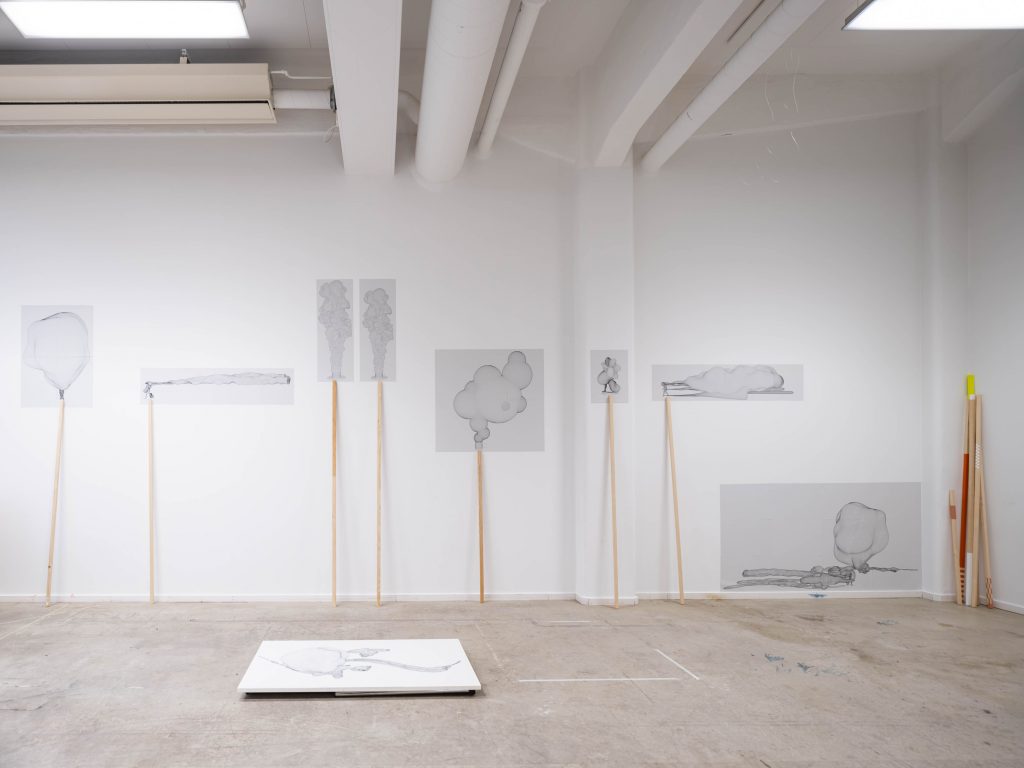
There were intellectual preparations: studies we had made throughout the previous semester, a set of drawings that explored the human umwelt, inspired by one of the readings in the course we were co-teaching with Post Humanities scholar and writer Dominic Pettman — Jacob Von Uxskill’s A Foray into the Worlds of Animals and Humans. We carried this to Stockholm, along with a small number of tentative sketches: half imagined notions for a fictional festival for non-human worlds. We had, at that time, initial discussions with NGV (The National Gallery of Victoria) in Melbourne, but the umwelt studies were abstract, esoteric, and inconclusive — discussions had stalled.
There were also logistical preparations: the careful packing of two rucksacks, making them as light as we could for a five-day hike the week before the start of the residency — across the raw, and wild landscape of Lapland, characterised by flat-bottomed glacial-carved valleys. Weather above the Arctic Circle in northern Sweden at the end of the summer can be sunny, but can also be severe. Plentiful water from the glacier melt meant we wouldn’t have to store or carry water, reducing our load. Not fully knowing the terrain, we had to make sure we had enough food, enough warmth and protection from the icy rain, and enough pairs of dry, warm socks.
To spend any time in these places requires a great deal of preparation and a realisation of how much of a struggle it is to exist outside the human worlds we have created with their abundant infrastructures. Entering these kinds of non-human worlds, you very quickly become aware the human is little more than biomass. Spending time in inhospitable places, under a small piece of tent fabric, sharpened our appreciation of these worlds. We knew that full immersion in planetary-scale landscapes would help mentally and emotionally to prepare us for the coming work we would do, buried in the studio in Stockholm.
Coincidentally, an additional twist: the starting point for the hike was in Kiruna, a town in the Arctic Circle that we had read was lifting its buildings and relocating them to a new city centre three kilometres away — something that ordinarily would not be considered remotely viable — wildly exceeding a “real” solution. And, as such, it was difficult to imagine the logistical challenge. And yet, here it was: enormous buildings being moved. This connected to another area of research we had been investigating — a study around the impossible, drawing from the edges of science, philosophy, and literature — including an imagined Archive of Impossible Objects. We had arrived in Kiruna just at the time when the process was half complete. Many places had two addresses and were straddling both locations, making navigation confusing. Whole areas lay abandoned, still waiting to move — extraordinary and surreal. We were very fortunate to meet with Klaus Thymann, the author of the study Moving a City – Kiruna, documenting the logistical processes required to do such an unthinkable thing.
So, on day one of the residency, we were prepared mentally and emotionally.
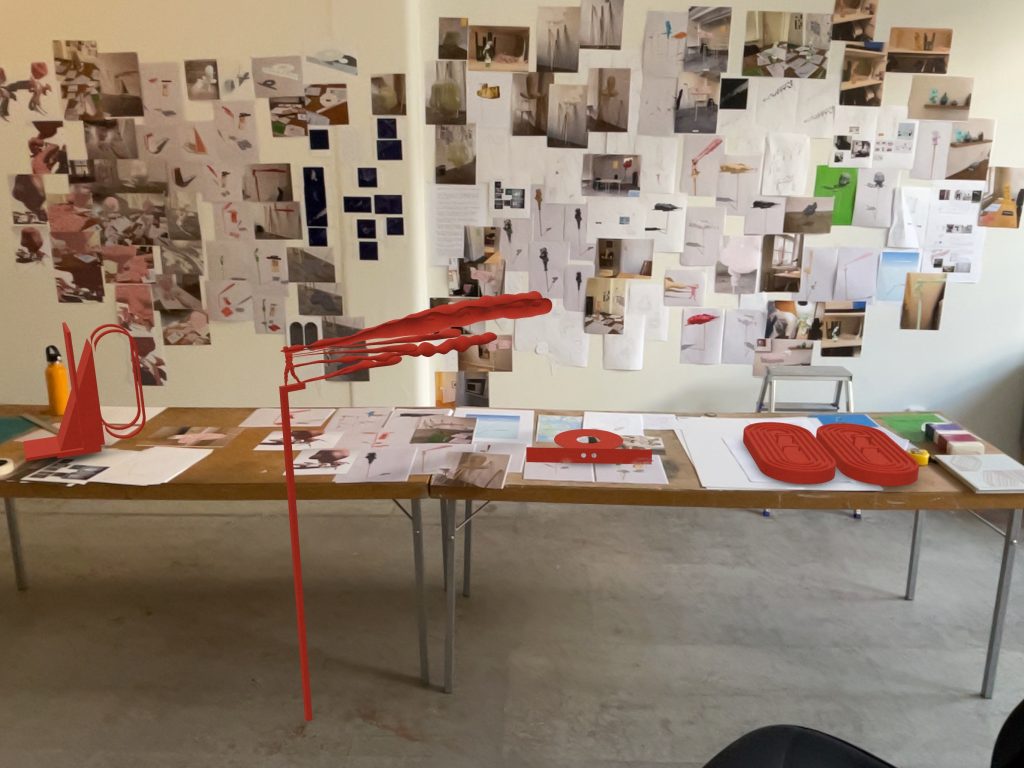
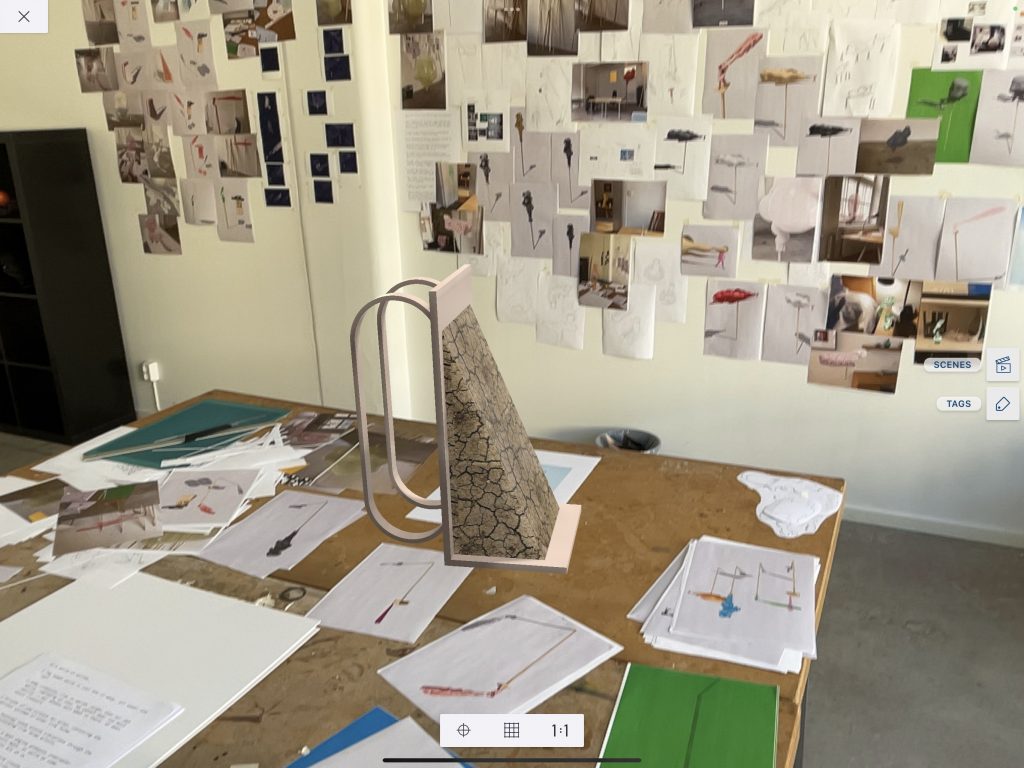
Having a large, dedicated studio space is something we miss after moving to New York City. Setting and mocking things up, checking on a natural feeling for the size of an object, pinning things up, testing out ideas with enough space around them to think and consider them in material form.
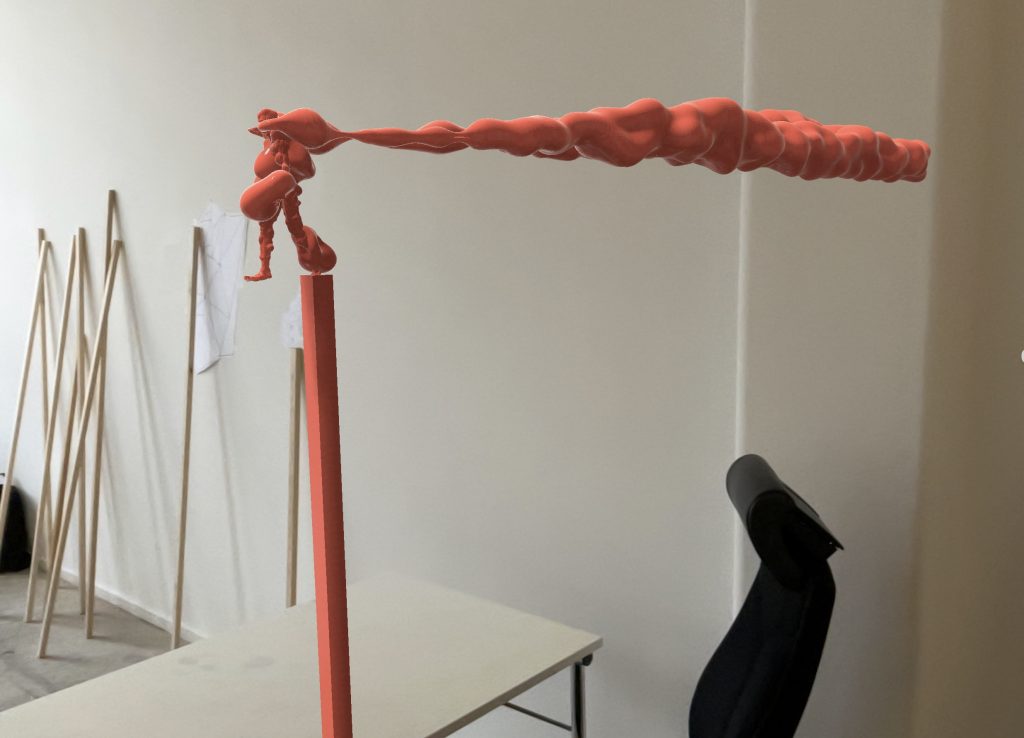
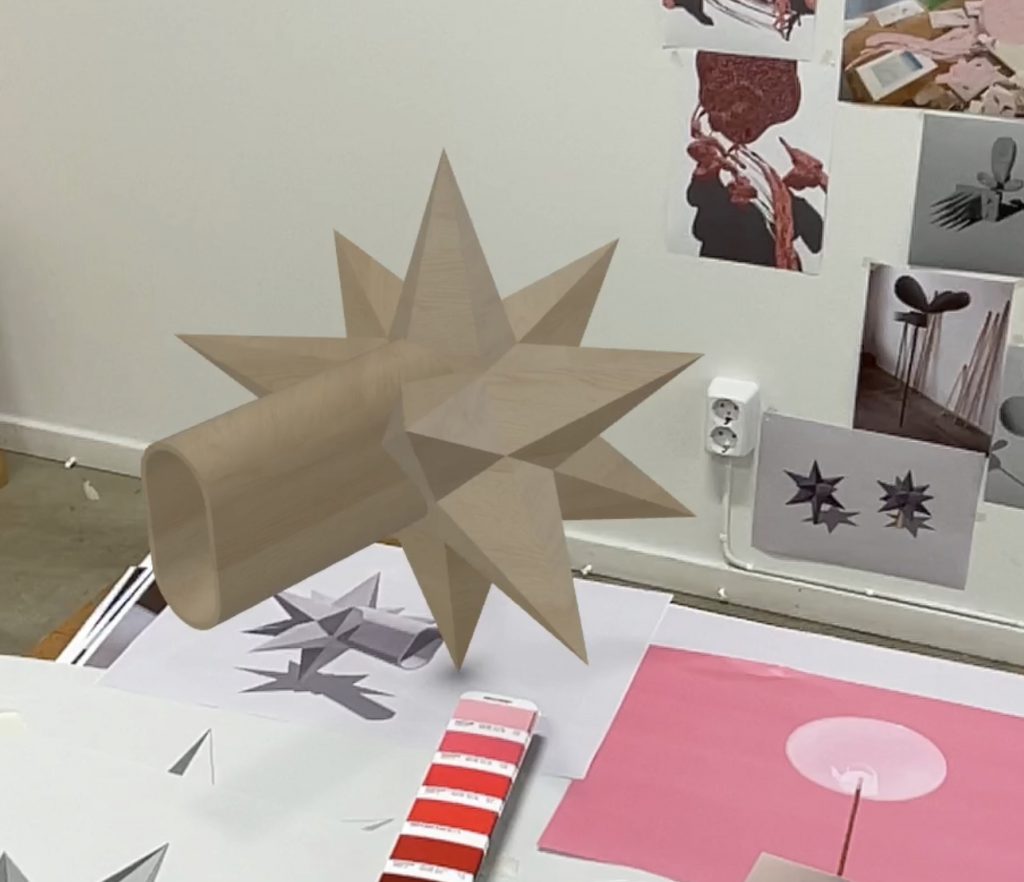
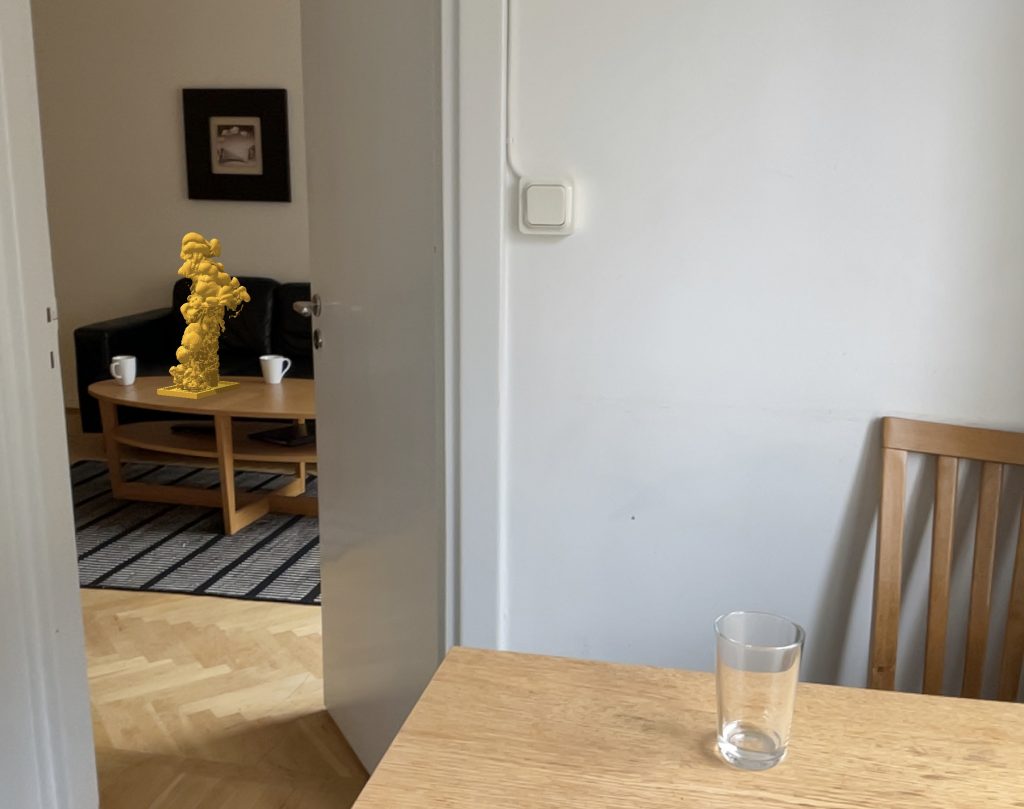
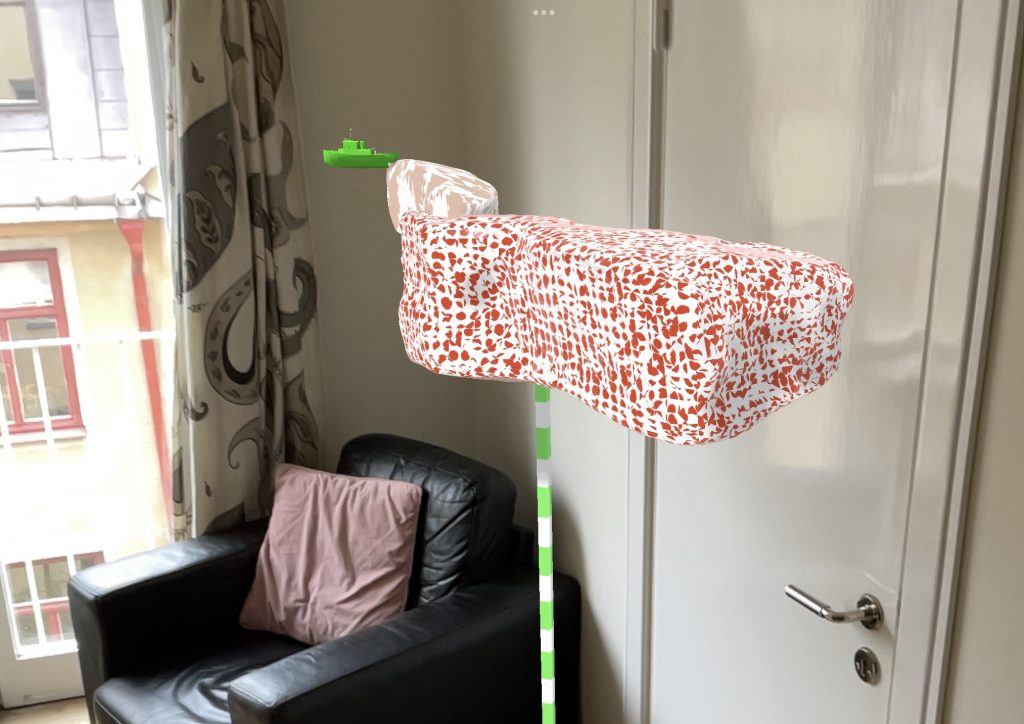
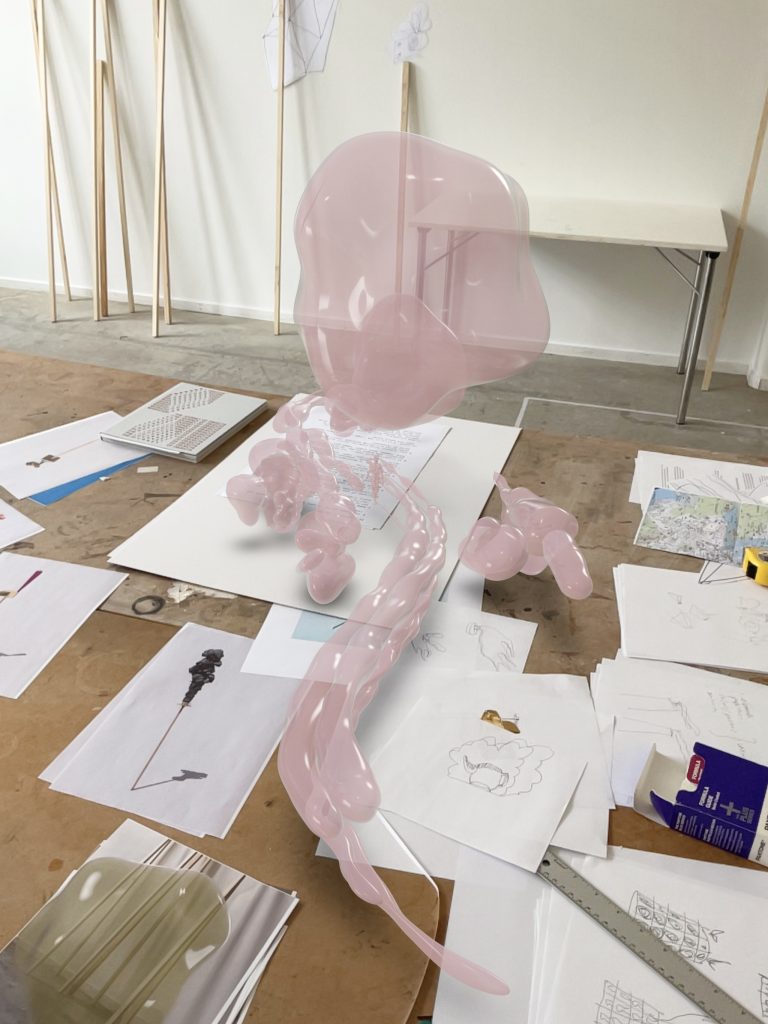
We had both been learning simple 3D packages on our iPads, and discovered there was an AR button that allowed the virtual objects to be projected into the space. It enabled us to scale them, to explore their materiality. Although still virtual, it gave us a genuine feeling for what they would be like, to walk around them, situate them on tables and in various locations. But also in domestic settings: in cupboards, in kitchens, hallways, and on shelves.
It enabled us to evaluate them, get a sense of the meaning the object communicated. It gave us the opportunity to explore and invent unexpected combinations, push the possible material languages much deeper than we would have ordinarily. We have always kept our objects a little ambiguous, utilitarian, indicatively “unreal”, however, it’s always been important that they physically exist in the world — but perhaps not entirely for the world as we currently know it. And deliberately so. These precious weeks were an opportunity to expand vocabulary, explore material meaning-making through material language and form, let them live for a while, get used to their strangeness, and see if they could endure — carrying them from one day to the next without distraction. We realise we work intuitively, and testing in this way takes much more time.
During your residency, you were invited to participate in the first forum we organised on design residencies. You spoke about how the residency at IASPIS was an opportunity to be outside of your day-to-day structure of work (teaching), daily routines, and place (New York). Could you expand on what this enabled within your work and practice?
Fiona
The residency created a much-needed momentum to our project.
It has also connected us back to our material practices of object-making, which have become increasingly more difficult to do as objects become more expensive and time-consuming to make. Within the broader discipline of design, there is less opportunity to focus in and experiment with object typologies, explore meaning-making in any great depth. It’s rare to do these kinds of investigations purely for their own sake. So this has been nice, to prioritise this core design work again.
Expertise has also increased. The threshold to learning a programme like Rhino is a little beyond us, so it was nice to have time to up our skills for simpler programmes that have enabled us to have a little more independence in our form-making. Enough to sketch out ideas, which has expanded into 3D studies with the purchase of a 3D printer.
It’s now over two years since your residency. Could you say if, and how, the residency has affected your practice and teaching?
Fiona
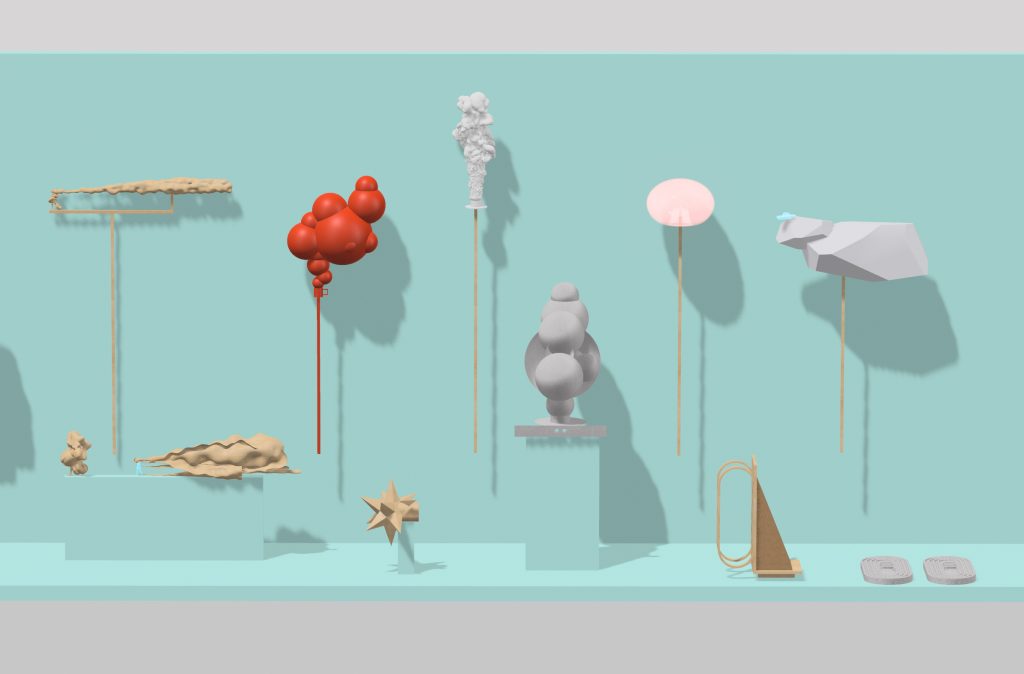
The residency was the momentum needed for the project. It continues to progress and is still very much alive — it continues to evolve. The conversations with NGV turned into a commission for the 2023 Melbourne Triennial (Dec 2023), supported by RMIT (The Royal Melbourne Institute of Technology), who tirelessly worked on the materialisation of 11 objects. The project was jointly supported by MUDAC (Museum of Contemporary Design and Applied Arts, Lausanne), and two sets were made.
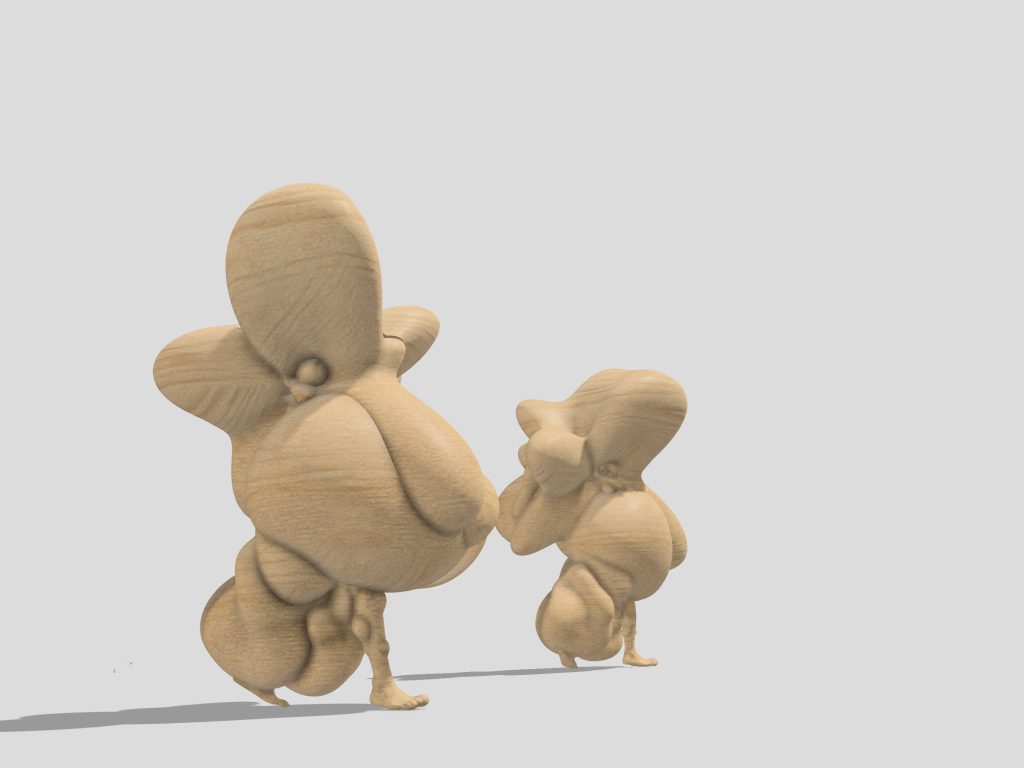
We worked over 18 months remotely with skilled CNC fabricators Mathew Fuller and Kevin O’Connor, local glassmakers, Jam Factory, and an expert mycelium practitioner, Joshua Riesel. A separate mycelium study came from a parallel commission from the Future Observatory, Design Museum, London, for their opening exhibition (Oct 2023). We worked with a start-up company, Osmose, growing the umwelt figures in mycelium. Having the mycelium digest the human adds another critical layer to the study. These growing experiments are still in progress.
Many essays, presentations, and talks have accumulated. The MUDAC pieces will be shown in a More than Human exhibition at the Design Museum (Jun 2025).
We have also set up a new teaching course based on the research, which will begin in January 2025. And the work is documented in a chapter in our new book, published by MIT Press — including a chapter on the Archive of Impossible Objects. Substantial parts of the book were written during the residency.
It could be argued that as the frames for design practice and research expands, the spaces and formats to practise design and do research become somewhat narrower. It’s becoming increasingly difficult to conduct independent design research outside academia and industry. Do you think that design residencies could play a role in supporting more independent forms of design practice and research, and if so, do you have any thoughts on how?
I am also involved with a year-long mentorship programme, Forecast, based in Berlin, which also leans into non-human research, but also hopes to push forward the material language explorations and storytelling elements. I have been working with an exceptional practitioner, Johanna Seelemann. As part of the programme, we did a study trip to Iceland — a week-long mini-residency at Nordic House, Reykjavik.
It became an immensely important turning point in the project. Hugely inspirational, Iceland is so raw and planetary, anything superfluous is immediately stripped away — romantic notions of the non-human are instantly evaporated. All the practitioners, scientists, curators we met are immersed in a sensibility where the everyday mundane becomes effortlessly poetic.
The study visit took us both out of our everyday worlds and mindsets, immersing us in a different reality. Johanna has a long relationship with Iceland, already closely connected to a community of inspiring people, but it was something about compressing so many meetings within a short time, being rained on and blown about every day, exposed to the raw landscape — of rock, lava, glaciers, ice caves, lava tunnels, and turf houses — confronted with extremophiles, moss, lichen, and spirits living within the rock, and, on the final day, an in-depth and illuminating discussion with Iceland’s leading soil scientist, Ólafur Gestur Arnals, where a whole set of different values reset the project. Johanna was able to disengage from over-rational thought, and let her imagination float a little more, experiment a little more.
These opportunities for extended practice are part of mentoring structures. I also mentored at New Inc, at the New Museum in New York, as the Creative Science Mentor-in-Residence for three years, convening 10-12 early- to-mid career, diverse, highly ambitious practitioners. A little like Forecast, it’s a hot house of disparate practice all thrown together, practitioners evolving their craft, stimulated by the multidisciplinary backgrounds and approaches. But additionally, New Inc addresses the economic harshness of New York City, providing additional support with creative industries business knowledge and methods borrowed from start-up culture. The community building and peer support are exceptional, providing the collective emotional support required to keep up the tough economic struggle. It’s a fast moving agency, it’s on fire! In a hyper-capitalist city like NYC, the need for this kind of mentoring is acute.
I do think design residencies and mentorships can play an important role in supporting more independent forms of design inquiry through practice and research. Both New Inc and Forecast are situated within larger institutional frameworks — New Inc within the New Museum, NYC, a place of contemporary arts research, and Forecast partnering with Radial Systems, Berlin, a well-known live arts venue. Both are set in very specific cultural contexts that help situate and frame the activity. Both support independent experimentation outside academia and industry. Both emphasise and nurture the communities that, over time, build around them.